
When Kley and I launched Jewkarta, in November 2020 (more than a year after we’d initially talked about it, during the first weeks of getting to know each other), we had a number of motivations.
Firstly, it provided a reason/opportunity/excuse for us to explore more of Greater Vancouver’s restaurants, both of us having been food obsessed for as long as we can remember. Secondly, the COVID-19 pandemic was at its height, indoor dining had been indefinitely banned and restaurants were in peril; we hoped that, in some small way, our efforts might help drive takeout/delivery traffic. Thirdly, we were both unemployed and in need of something to do, individually and as a couple.
And lastly, I knew, having served as food editor at a couple of local city magazines, that chefs, cooks and restaurateurs are some of the most entertaining, ambitious, opinionated and quotable (and, occasionally, deranged) people one could hope to meet. What with my journalism career having died several years prior (in tandem with the magazine industry itself), here was an opportunity for me to reconnect with the fascinating behind-the-scenes world of hospitality and for Kley to experience it for the first time.
In the two and a half years since then, Jewkarta has become far more rewarding than either of us could have predicted — especially the extent to which we’ve been shown appreciation by (and even forged a few important friendships with) people in the industry.
For some time now, we’ve been discussing adding interviews with people from the restaurant world to our content mix. And now that my recent health issues have restricted me from dining out (and eating in general) with the total freedom I’d previously enjoyed, this would allow me to start making a significant contribution to Jewkarta again after months of absence.
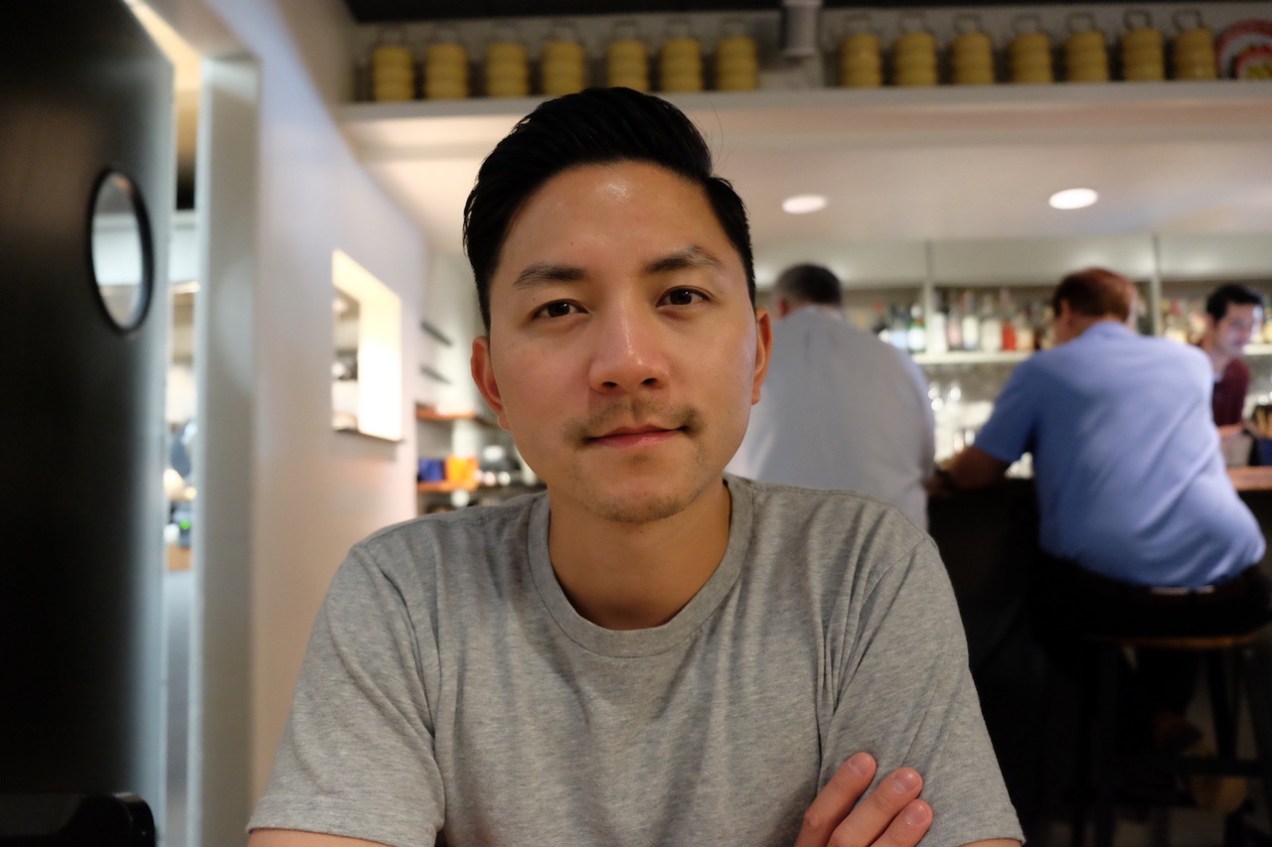
So, here’s the first of those interviews — and it was easy for us to pick the person with whom we wanted to begin. Not only are we in love with the two Thai-themed restaurants Terence Feng cofounded (Kin Kao and Song); he’s shown us an overwhelming degree of kindness, generosity and support. And in direct contrast to Vancouver’s notorious social frigidity, he actually sought us out because he liked what we were doing and figured we should meet. We’re kind of in love with him too.
Terence seems like a natural-born restaurateur: both of his dining ventures have been a great success. While he’s no longer a day-to-day presence at the still-popular Kin Kao, Song has been a blazing triumph from the moment it opened its doors in November 2021, even earning a prestigious Bib Gourmand designation from the Michelin Guide toward the end of its first year of operation.
All of which makes it fascinating to learn that Terence basically became a restaurant owner by chance, and he doesn’t intend to remain in the industry forever.
This interview has been edited for brevity and clarity.
What’s your earliest memory of being taken to a restaurant?
That’s a good question — I’ve never been asked that! I think, growing up, going out to eat was never really a thing. Food was very much “You eat to live.” We were definitely not well off. I’m the youngest of two siblings in a family that my father… it was his second marriage. He had spent all his wealth bringing his first family from Hong Kong to Vancouver — God knows how much that would’ve cost, because there were nine members, including him — so by the time he had remarried some 15 years later and had me and my brother… We left Hong Kong when I was seven, so my memories of there are minimal. We were new immigrants here and my mom was the only one that was working — she was a seamstress, working 16-hour days — so we didn’t have any money. Trying to learn the language and fitting in was my early childhood. What I do have a memory of is getting McDonald’s when they had the cheeseburger special, which I think was 25 cents a cheeseburger — one for my brother and I to share. When we did otherwise go out to eat, it was always a Chinese restaurant, but I don’t have a memory of where. I didn’t have exposure to anything else until I made my own money.
And when did that happen?
I was making over $100k at the age of 22, in web development. I was very lucky, but also very hard-working. I wasn’t taking a vacation, I wasn’t buying a car; I was paying off my student loans and saving my money to put a down payment on a condo — that was really important to me. And then, once I was able to accomplish a few more things, I was like, “OK, I’m splurging now.” But it’s not like I was going out every single night; I was experimenting and trying new cuisines. I never had a palate for food until I was in my early 30s.
In my early to mid 20s, I was dating a lot and I was trying to impress these girls, so I would cook for them. And I just remember how hard it was to try to follow recipes, and the biggest part of that was because I was trying to be too fancy, too quickly. I would always screw it up. So I gave up and would take them to restaurants — I would rather just pay for it. And I discovered, “Wow, I really just enjoy dining out. The whole experience of it.” I’m not a lazy person — I don’t mind doing dishes or prep, or shopping for ingredients — but I could have whatever I felt like, because I was making my own money and I could just walk down the block and have Thai food. Or, if I was feeling junky, I could have McDonald’s. I was blessed enough to be able to afford it and live in a place where that was within reach. Going out to eat, I made the most of it every time, because I realized I was privileged.
And so once you started dining out regularly, which places did you like best?
It was after I started Kin Kao, and it was Kinome Japanese Kitchen. It was, by far, my favourite restaurant. I felt like every time I walked in there, it was like, “I think this is what it would feel like if I was a part of the TV show Cheers.” It wasn’t just the recognition from everybody; it was a familiarity of the smell of the place and the food. I knew what I was getting and I knew that I’d love it. I would drive across the city to go there. When it closed [in 2018, after being evicted for a new condo development], it was hard for me to sleep. To this day, it’s my favourite restaurant in the city.
And I still eat McDonald’s consistently, because I was always told “No” [as a child]. I don’t go crazy; I’ll have a medium fries and maybe a cheeseburger. Five minutes after I eat it, I feel like shit. … Asian food done well is just so fucking good that Western food just pales.
Given that you were already 30 when you started to really appreciate restaurants, what made you want to open one of your own?
I’d never been a risk-taker. When I left marketing [his career field after web development] and decided I wasn’t going to do it anymore, it wasn’t because I wanted to open a restaurant. I just needed to do something else, but I didn’t know what that was. I’ve always been an opportunist, but in a way that I was never the main idea person. Somebody came up with an idea and they needed someone to help push it forward. I was that guy. I was now 30 and I had all this money in the bank, but I couldn’t do anything with it that made me happy.
I was spending my entire life’s savings to open Kin Kao when I had zero restaurant experience. I even took a 10-month course on finance for restaurant owners. And Tang [Phoonchai, Kin Kao’s co-founder and executive chef], I’d known him at that point for 10 to 15 years. Six years prior, he did mention — maybe not directly to me, but as part of a group — that he wanted to open a restaurant. When he heard that I was leaving [my marketing job] and doing something new, he was like, “Let’s have a conversation. Let me cook for you, the type of food I want to do. Let me know what you think.” I could see it working, but I needed to think about it. It was probably a month before I made a decision. It was going to cost my entire life’s savings, but maybe this was what I needed. What was the worst that could happen? I’d go back to [work in marketing]. I sold my condo and moved back home; I was living in my mom’s basement. It was like the entire weight of the universe was on me, to prove to myself that I wasn’t gonna fail.
Opening up Song was very much the same: It was almost like, “You never believed in yourself, you never thought you were good enough, so maybe this is what you need to do.” I definitely don’t want to do this for the rest of my life, but if I was going to continue to do it for the next 10 years or so, it had to be different. I needed a bigger challenge. If I was doing the same thing [as Kin Kao], I’d be doubling my anxiety but also not feeling accomplished.
What was your initial vision of what Song would become?
It was supposed to be refined street food, and it became nothing like that. Now I would call it authentic Thai at its core, but very experimental, seasonal and local.
If you could change one thing about the restaurant scene in Vancouver, what would it be?
Not just for Vancouver — maybe for all of North America and Europe: consumer etiquette. Not even being on the receiving end. Sometimes when I dine out and I see the way some people behave… But that’s not just dining — that’s just a general statement. As a whole, society needs to be a little more considerate of others. Just don’t be rude. Treat people with respect, in the way that you’d like to be treated — and that should apply to every part of your life. We can always treat each other better. It’s a good feeling.
 Jewkarta