
Visit our Instagram page
It sounds implausible, but before Suyo opened in August 2022, there wasn’t a single Peruvian-themed fine-dining restaurant in all of Canada. And it remains the only one of its kind to this day.
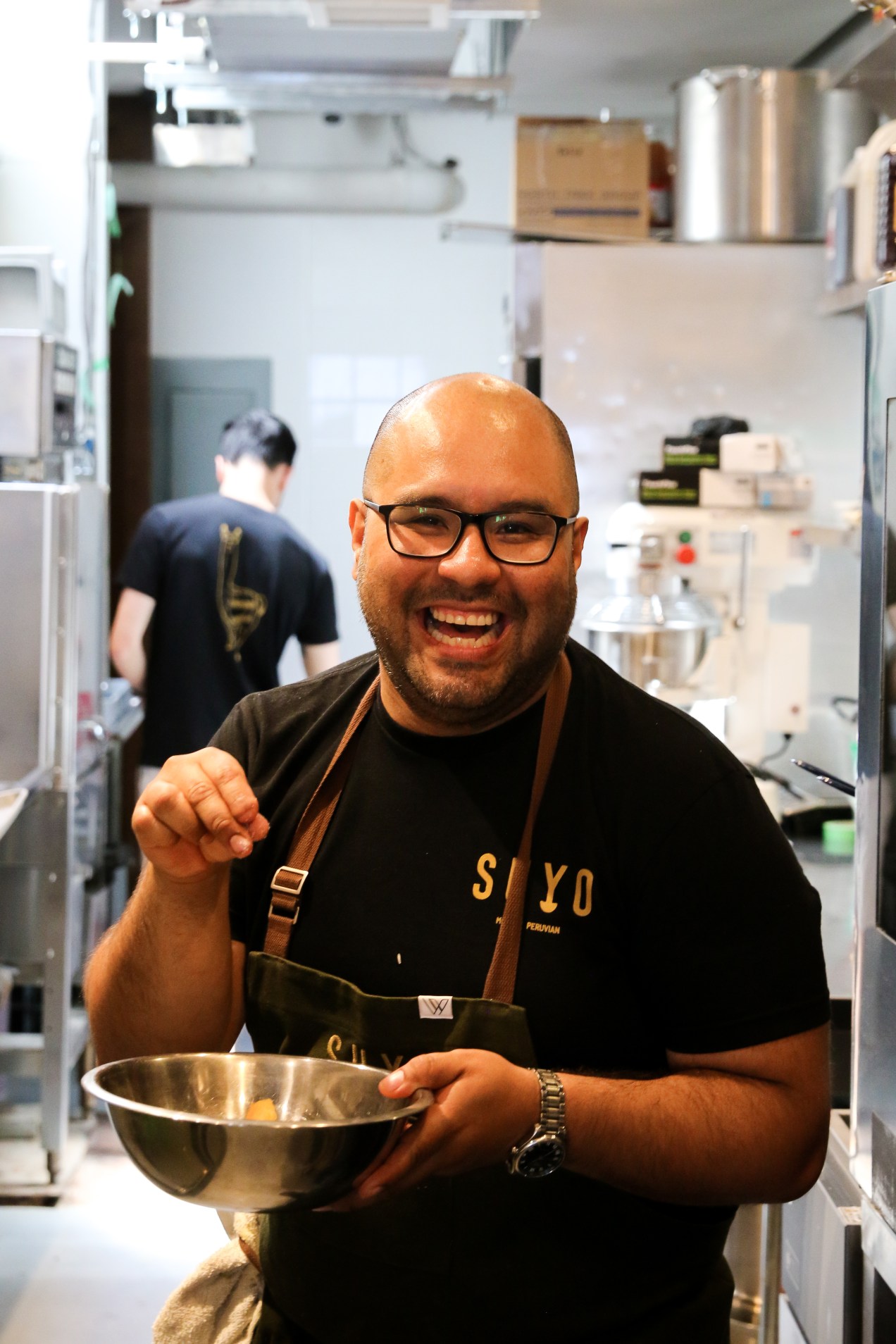
Suyo wouldn’t have existed without the vision of Peru-born chef Ricardo Valverde, who moved to Vancouver with his family in 1998. After culinary school, he worked at Blue Water Cafe and Ancora, two of the most revered seafood restaurants in the city. But Suyo, Valverde’s first venture as both chef and owner, is a highly personal tribute to (and elevation of) the distinctive cuisine of his homeland (hence the name: Suyo is the South American Indigenous word for “homeland”). Despite its newness, Suyo has already earned a Michelin recommendation, as well as Michelin’s Exceptional Cocktail Award.
Here, Ricardo shares how he evolved from the humiliation of his first Vancouver restaurant job (he was fired after four hours in the kitchen) to become one of the city’s most distinctive and celebrated chefs.
This interview has been edited for brevity and clarity.
What’s your earliest memory of being taken to a restaurant?
It was at my elementary school. There was a kiosk inside the school, run by the wife of the janitor. Sounds kind of weird, because you wouldn’t see that here, but it was a different time and a different kind of situation. This school was half private, half public; my dad used to work for a bank, and the children of bankers would get 50 percent off in this school. It brought all kinds of people together — very poor people whose parents [otherwise couldn’t] afford a semi-private education, and the children of parents who were like, “Okay, I have money, but if I can spend less….” (laughs)
So, there was this kiosk and there was this lady; her name was Elena and she sold food. Actually, there were two kiosks: There was one where you could sit for a full meal, and then one of them I just remember her selling chorizo sandwiches with fried egg; nice baguette-style, kind of like ciabatta but crispier, fluffier, lighter. She would wrap it nicely and cut it in half perfectly, and that’s my first memory of the exchange of food for money. I was seven, eight years old. I’d give her money and, in return, I’d get a sandwich. I was like, “That’s so cool!” And I would never buy just one; I would buy two or three. For me, food has no limits, so I’d eat until I couldn’t eat any more, basically. And I would go home and try to recreate what this woman was making.
What was your age when your family moved here?
I was 17.
Did you already have an inkling, before you moved to Canada, that you wanted to work in restaurants, or did that not come until much later?
Much later. The idea of working in kitchens was not even an option for me, because growing up in a middle-class Peruvian family, your parents will never encourage you to work in a kitchen. Both of my parents are engineers. When I came to Canada and I found out I was able to work — like, back home, I probably wouldn’t have worked until I was in university. If you’re middle class or higher, sometimes you don’t work. If your dad makes enough money, you don’t have to worry about work. Usually, the people who work minor jobs there — they’re like student jobs here, and these people need to work because their parents just don’t have the means. So, we came here and we understood that the culture was “Everyone works.” And I was like, “All right, I’m ready!”
You were excited about that.
Yes. My first job was at a place called Pasadena. In school in Peru, I took this home-ec cooking class, so I put it on my resumé, and then I guess [the owner] took it as my having gone to cooking school. But I got there and I didn’t know what a Caesar salad was — nothing, right? (laughs) My saving grace was that she gave me a menu, I studied it, and then I picked something on the menu like shrimp, and I had to clean it. I had never seen a shrimp in my life… She fired me the next day. I remember she asked me for a ladle, and I didn’t know what it was. I think I gave her a pot instead, or a wooden spoon. She said, “I thought you went to cooking school!” She’s just screaming at me. I was like, “Yeah, in my high school.” She had me wash dishes that night, and that was it. “Come pick up your cheque.” The minimum wage at the time was $7.15. I did four hours. I picked up my $28, minus tax.
Why did your family decide to move here?
My first memory of us thinking of moving to Canada was, we had this big framed picture in our living room, and it was a map of all the countries with all the information — population, language, all of that. I was looking at it one day, I was a probably eight or nine, and my mom said, “One day, we’re gonna go live in Canada.” So, my parents always had that in the back of their minds. My parents always wanted to give us a better future…. At that time — 1996 — I remember they were giving out a lot of visas, especially if you had a good career and a lot of kids. Our family had four boys. We ended up getting a lot of points to qualify for residence. Within six months of applying, we got approval for residence. But then there was a long wait and we moved here in March of 1998.
Vancouver was your first choice?
That’s what they gave us.
It was assigned to you?
You never choose. They tell you where to go. But after that, you can choose wherever you want.
I never knew that! But you haven’t left Vancouver, so obviously there was something about it you liked.
I remember we went to New York for a couple of weeks first, before we moved here. I was asking my dad what Vancouver looks like. We drove to Philadelphia to see some family, [who lived in] a really nice neighbourhood. My dad said, “This is what it looks like.” Everything was super clean; a nice suburban neighbourhood. My dad had come here a year prior and he stayed in Richmond, in the front of a church called St. Joseph [the Worker Parish] on Williams Road. He came here to check out jobs and things, and we ended up living three blocks from there, just coincidentally. And I ended up getting married in that church, and my parents live a block away now.
Was there one particular event, or one particular thing you ate, that made you decide you wanted a culinary career?
More than eating was the experience, the whole. When I came to Canada, I started working in fish-and-chips places in Steveston. My friends in high school worked there — one of them was a senior cook — so they got me a job. I started as a dishwasher and then I moved to the line. My first job was in a place called Shady Island… So, when I worked there, I was like, “This is cool, making salads!” And I thought, “Do I need to go to school for this? Are they gonna just let me do this?” I was maybe a little traumatized from my first experience [at Pasadena], that made me think I need to have an education. Then that job came abruptly to an end because I had an accident and was out for, like, six months.
And then one day, I was sitting down with one of the main guys that ran the kitchen, and he told me that there’s a bigger world out there. Like, you know, “What you’re doing is nothing.” I think he was quitting. And I said, “You do so well here. Don’t you want it as a career?” He said, “Noooo.” I think he’s a broker now.
How old were you at the time?
Eighteen. I was like, “I love this. I want to learn more.” He was like, “Ricardo, there’s a bigger world out there.” I don’t know why, but he said to me, “You have to be Chef de Cuisine.” Those words stuck in my head.
Did you even know what Chef de Cuisine meant?
No, no. He said it was French.
And then, I was in love with a girl. I was hanging out with my friend, Alvaro — one of my best friends from cooking school. It was a Saturday night and we went to this place called Cloud 9. In those years, it was one of the fanciest places in the city. And I just remember seeing this cheesecake that comes with, like, the [decorative] dots and then they do the line [on the plate], like the old-school fine dining. And I looked at the view and the tablecloth, and there was the music, and I was thinking, “Holy shit, what is this?”
You’d never been in a restaurant like that before?
No, never. So, then I see this restaurant and I think, “I gotta bring this girl here.” I asked her out on a date and I brought her there. And then we’re eating and everything’s so delicious, and this girl tells me about how her family is so close to food and wine, and how her dad loves this and that. At that point, I’m thinking, “Okay, I gotta be a chef now, ’cause I’ve got a girl.”
So then, I remember we’re sitting there, just having dinner, and she taps me and then I look up. And then there’s the chef, with his big hat, super clean, white jacket, walking by all proud. And in that moment, I was just like, “Fuck, I love this.” I just got drawn into it — the experience of dining at a fancy place, and the service and the wine. That was when I was like, “I’m gonna be a chef.”
But obviously, being a customer in a fine-dining restaurant — or any restaurant — is very different from the reality of working in the kitchen.
t’s true. But I tell you, I love being in the kitchen. I never think of the kitchen as bad. I love it. There is not a point where I’m like, “Fuck this.” After we finish this interview, I’m gonna go in [to Suyo’s kitchen] and prep. I prep with the guys; I’m one of them. I could find someone else to do it, but I love being in there. I can’t pull myself out of that. When I took a sabbatical for three years [after Ancora], I went into a fucking huge depression. I worked as a private chef for a very wealthy guy for a while, but it wasn’t for me. I was depressed doing that, too, because I’m cooking for only one or two people, and then there were all these restrictions of how these people ate. I needed to be on the line, creating features, mentoring younger people. I’m addicted to it. I’m addicted to that good stress.
Why do you think no one wanted to do a Peruvian fine-dining restaurant before you?
You need to have someone with a background, who lives here and who understands the market. If I wanted to open a restaurant in Toronto tomorrow, I don’t have any contacts, I don’t know any suppliers, I don’t know who gives you the best tuna in town. I grew up in Vancouver — I know everyone here!
Which do you think is the most underrated restaurant in Metro Vancouver?
What comes to mind is Yuwa, the Japanese restaurant. I always recommend it to people. A lot of people haven’t even heard of it. Make the drive there — it’s a beautiful drive, a beautiful neighbourhood. I love the experience you have there. And they have something for everyone: If you want a California roll, they have it for you. (laughs) If you want a nice omakase, they do that too, and it’s beautiful.
(Photo: Chelsea Brown)
 Jewkarta