Visit our Instagram page
By Michael White
Anh and Chi is one of Metro Vancouver’s greatest restaurant success stories of the past decade. Since day one, in 2016, its authentic yet elevated interpretation of traditional Vietnamese cuisine has proved so popular, it looks strange for there to not be a lineup extending past its Main Street storefront.
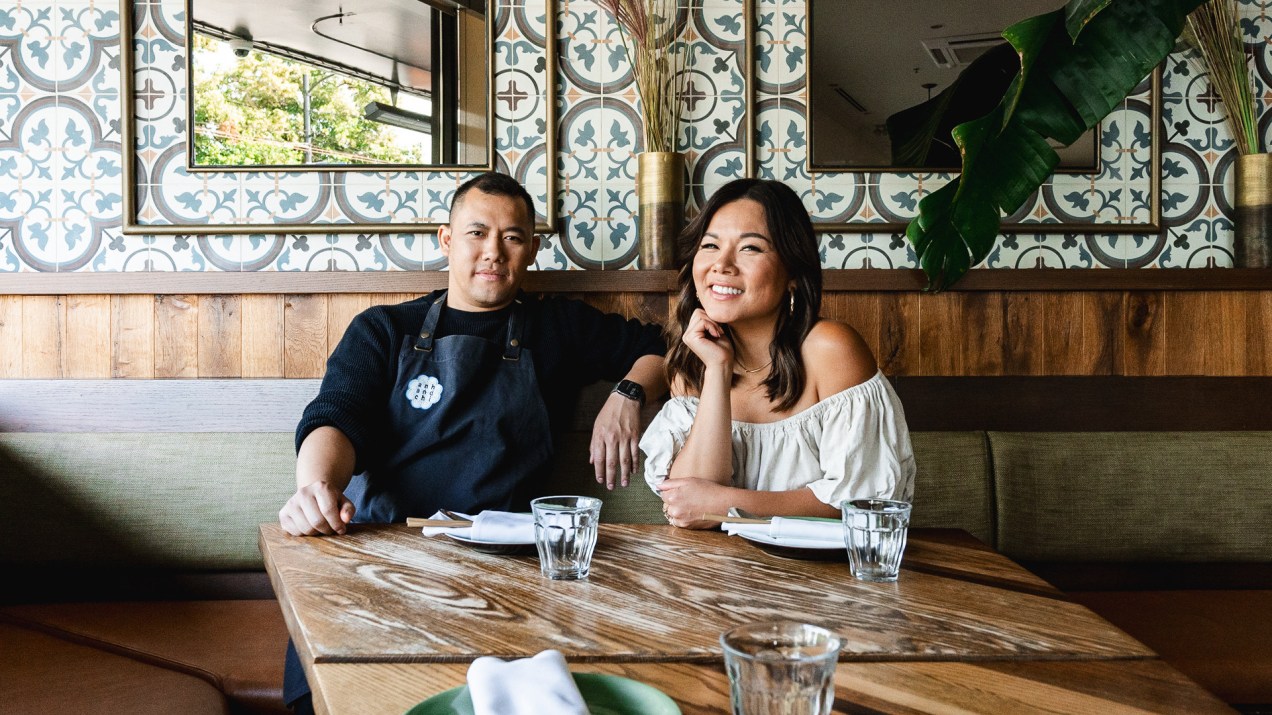
The restaurant’s owners, siblings Amélie and Vincent Nguyễn, opened Anh and Chi (its name translates as “elder brother and sister”) in the space that previously housed their refugee parents’ beloved Pho Hoàng, said to be Vancouver’s first pho specialty restaurant. When family patriarch Hoàng passed away, Amélie and Vincent decided to forego completing their university educations and instead honour their parents’ legacy with a new, modern dining destination. Eight years later, it remains as popular as ever (possibly even more so, after receiving a Bib Gourmand designation from Michelin). Amélie and Vincent’s mother, Lý, retains a crucial role in Anh and Chi’s success as its executive chef; in fact, her own home cooking has always been one of the menu’s primary inspirations.
Most recently, just weeks before the following interview took place, the Nguyễns opened a new venture, Good Thief, in the space next door to Anh and Chi. Like its neighbour, the interior and menu offerings at Good Thief are impeccable. Unlike its neighbour, the concept is more of a lounge, where inventive cocktails are served alongside small, shareable dishes such as fish-sauce-glazed frog legs, and an incomparable version of pommes frite, served with curry leaf and Thai green-chili aioli.
Yet despite being in the midst of what may be the busiest period of their lives, Amélie and Vincent radiate calm and happiness — the glow of contentment that comes from knowing their hard work is being rewarded by the love and devotion of their community, as well as guests who come from near and far to experience a meal imbued with decades of pan-generational experience, meticulous attention to detail, and, Vincent repeatedly emphasizes, “love.”
This interview has been edited for brevity and clarity.
What’s your earliest memory of being taken to a restaurant?
Amélie: I can’t remember! We grew up very poor, and so we didn’t have the money to go out to eat. My mom and dad, they arrived [in Canada] as refugees in 1980. They used to buy the spines of chickens, because they couldn’t afford the meat. The cheapest part was the discards — the bones, the spine — and they would bring it home and they would braise it or deep-fry it and caramelize it. It was all they could afford, but it had amazing flavour.
But actually, my first childhood memory of a restaurant was the old Pho Hoàng, at Main and 20th. At nighttime — probably 9:00 or 10:00, and I was maybe six or seven years old — I would go with my two cousins, and we would skim the fat that rises to the top of the pho, which would simmer for 20 hours. In order for the pho to be very clear, all of that has to be taken off. We would occasionally scoop out a beef bone and eat the marrow, and it would be so sweet because of the spices and seasonings from the broth. We would dip it into hoisin sauce and my mom’s chili oil.
Were you curious about western food — particularly fast food and whatever you saw the white kids eating at school?
No, I don’t remember that.
You never were intrigued by McDonald’s or anything like that? It must have seemed exotic if you’d never had it.
Eventually we did go to McDonald’s. I remember my mom taking me to the one on Main. There’s still one there now, but it was different. It had a merry-go-round, and I remember eating [McNuggets] and fries, and eating it with honey. My mom introduced me to honey with chicken nuggets!
And I would go with my best friend to Riley Park — the skating rink — and there was a McDonald’s there. We didn’t have money, so we would ask for ketchup and we would eat the ketchup. We said we were “ketchup sisters.”
That’s tragic and adorable.
I know! (laughs)
[At this point, conversation turns to one of Amélie’s uncles, Tom, with whom she closely bonded when she encouraged him to come out as gay to the family. He did so a few months later.]
[Tom] is a restaurateur in Seattle, and now he owns a gay club in Capitol Hill. His restaurant, Tamarind Tree, inspired us to do Anh and Chi. We saw how successful it was, serving authentic Vietnamese food, but making it more elegant and beautiful, and pairing it with cocktails. And because it worked in Seattle, which is very close to Vancouver, we were like, “We can do it here.”
When you were preparing to open Anh and Chi, did you bring in any outside people to develop the menu, or was it just your mom?
My mom, but also my Aunt Mary and Uncle Tom. My aunt actually sacrificed a month of her life, away from her husband and her children, to come live with us in Vancouver.
Also, my mom, my brother, my sister and I, we took a family trip to Vietnam to get inspiration and make sure things would be authentic. We went to the north, where my mom’s home was. I jotted down all the things I ate, whether at a relative’s house or on the street or in a restaurant. Then we went down south to the Mekong Delta, to visit my dad’s side.
So, the inspiration for the menu came from our trip in Vietnam, and also dishes where it was like, “Mom, you make this at home” — like her caramelized fish — “Let’s make it here, too.” But we would use B.C. fish. Like, in the winter, we use Arctic char; recently, we’ve used sablefish. We try to bring in local ingredients that are sustainable, and then we incorporate that into our Vietnamese recipes.
What about, for instance, the plating, or choosing the glassware and the plates? From the very beginning, it was so sophisticated and so unlike what someone expects to see at a Vietnamese restaurant.
That’s all Uncle Tom. That’s all ‘Gay Uncle Tom,’ of course. (laughs) He actually found a source for the [place settings] in Vietnam — this village, an ancient village, and they make ceramics. He ordered so much for his restaurant that he was like, “You know what? You’re opening a restaurant. Just come to our storage locker and take some.” All of the dishes were made in Vietnam and hand painted.
Vincent [oversaw] more of the structural things, like the pipes and the water and the air con, and the stoves and vents.
How quickly did you realize that the success of Anh and Chi was exceeding your expectations? The lineups and the waiting list — those were there from the beginning, right?
Day one. We were blown away. We opened and then we had to close early that day because we ran out of everything. And there was no marketing, no PR. It was our parents’ legacy: The community knew that the children from Pho Hoàng were opening up a restaurant. And all the media outlets, like Vancouver magazine and the CBC, they all reached out to us. We didn’t work with a publicist.
Did you then have to scale up very quickly to meet the demand?
Our team grew. And the beauty was, because we had to scale up — it was great, because there were people who were very ambitious, that wanted to grow into management, and so we were able to grow, too. Part of the responsibility of being a business owner is, you’re growing with your team, and if you want to keep working with them, you have to be able to create a dream big enough to grow with.
[Vincent arrives and Amélie lets him take over the conversation while she tends to a meeting with the Good Thief team.]
How did you end up acquiring the space next door to Anh and Chi? It was a great stroke of luck that it became available.
Vincent: During the pandemic, a lot of places went out of business. Unfortunately, the hair salon and the framing store [that previously occupied the space] also went out of business. We have a great relationship with the landlord for Anh and Chi, so the landlord approached us and said, “Hey, do you want to expand?”
Did you ever contemplate just making it an extension of Anh and Chi?
We did think about it. But, you know, Anh and Chi is already a well-oiled machine, and to mess with that, it would add a bit of headache. I had wanted to create something of my own — my own identity, something that’s not a family-run restaurant.
So, Good Thief is more your project?
Yeah, it totally is. It’s the little brother going against tradition, following no rules, being rebellious.
Was it difficult to sell the idea to the rest of the family?
No, not at all. I think selling the idea of Anh and Chi — “Hey, Mom, I’m dropping out of med school and opening a restaurant!” — that was the hardest thing to do. It finally dawned on her: About four or five years [after opening], she had dinner with me and said, “Hey, you know, I’m proud of you for leaving medical school.”
What was the length of time from acquiring the Good Thief space to opening?
That was about two years. There were a lot of hiccups. Don’t build a restaurant where there’s no existing restaurant. Don’t do that. (laughs) But the benefit is I can be at both places at once. I don’t have to cross a bridge to tend to another restaurant.
There was no point at which you thought, “I’m busy enough already”?
Yeah. But we have to grow. We have an amazing team and they need to grow. And by growing, we can allow opportunities to meet new people, bring in new talent, and also expand.
Was Good Thief inspired by other places, not in Vancouver but elsewhere?
Oh, yeah. New York, L.A., in Japan, in southeast Asia. And that’s the whole idea behind the name Good Thief. It was us going around the world, stealing these ideas — the cocktails, the design, the service — and bringing them back and sharing them with the community.
 Jewkarta