Asian Fusion, Thai

Review: Jay Nok

Visit our Instagram page to see more photos

By Michael White

Thai food in Vancouver has evolved immeasurably throughout the past 20 years. It wasn’t so very long ago that most Thai restaurants’ menus were filled with concessions to the fragile, spice-averse palates of white clientele (spring rolls; stir-fries and noodle dishes as bland as a Coldplay ballad). But the trailblazing likes of Maenam and, more recently, Song and Baan Lao have seduced the masses without sacrificing authenticity. Thai, we all quickly discovered, is among the most sophisticated, nuanced, yet accessible cuisines in the world, and all we’d ever needed was for someone to take the risk of serving it to us in a welcoming setting and wait for our faces to collapse in revelation and pleasure.

Sala Thai, said to have been the first Thai-owned and -operated restaurant in Vancouver, endured for a remarkable 38 years, most of that time in a sprawling space near the bustling Burrard-Robson intersection. Although it settled into an unwavering groove decades ago, it remained in the good graces of everyday diners as well as critics, who praised its consistency and uncommonly cordial service. When its imminent closure was announced in April of last year, no specific reason was given, but its founders and owners, wife and husband Joy and Sam Kongsilp, shared the cryptic remark that “this is not goodbye,” adding, “We look forward to seeing you all again at some capacity in the future.”

That capacity is now here in the form of @jaynokthai in Olympic Village. All vestiges of the room’s former tenant, The Flying Pig, have been erased, and aside from some decorative motifs that nod to Thai heritage, the space is modern, raucous (a DJ on the night we visited was slaying the crowd with a playlist of ’90s R&B bangers), and meant to attract as many demographics as possible. Joy and Sam’s son, Bobby, has taken over as co-owner alongside executive chef Bumpen “Nok” Khangrang (@chef_nok), who also happens to be his wife.

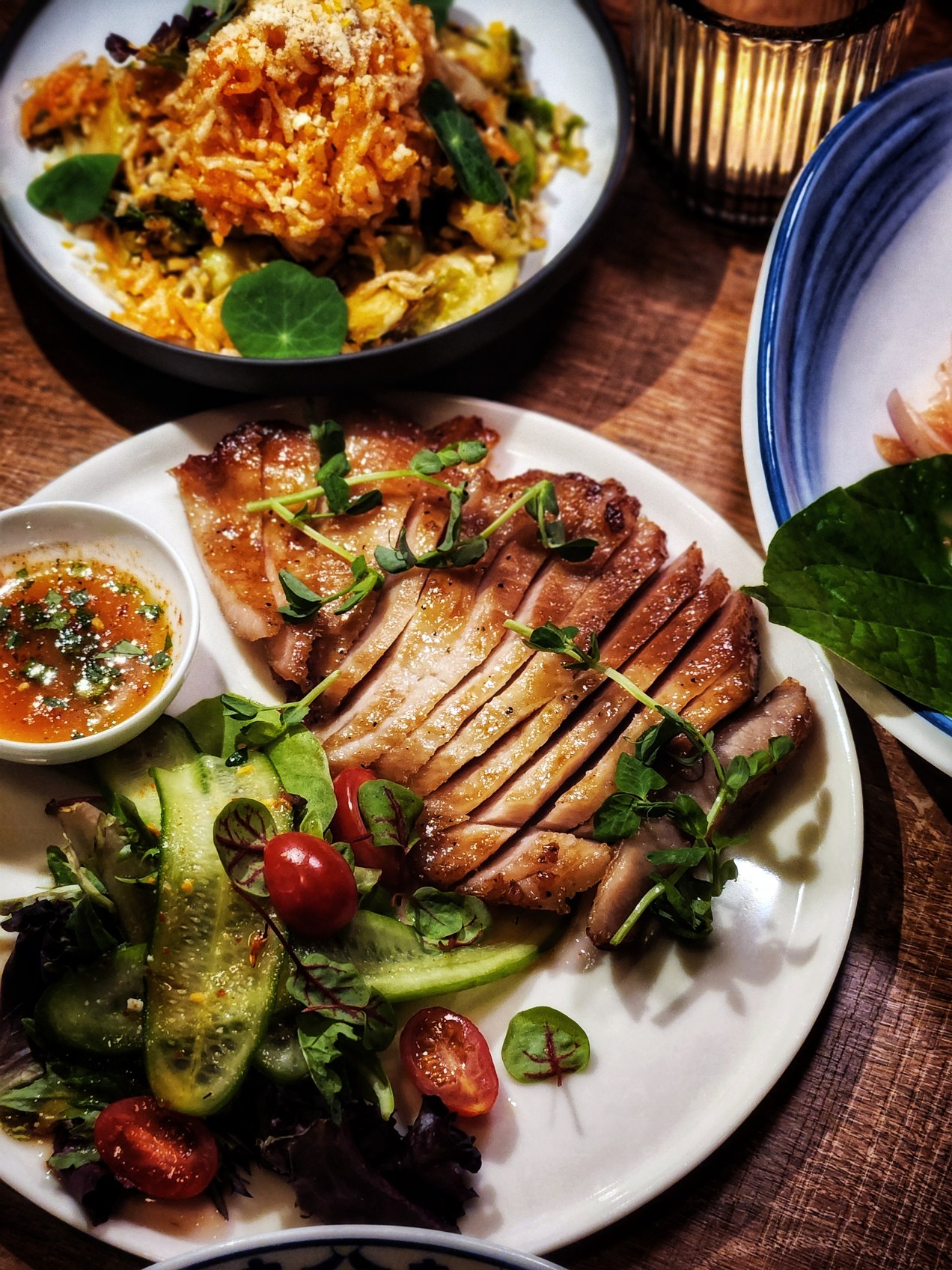
Khangrang’s dishes, developed with consulting chef @clement.kitchan, deftly walk the tightrope between tradition and an acknowledgment of what the masses want to eat nowadays. Non Khai chicken wings, tossed with cilantro and fried garlic, are sensational, while grilled pork jowl (pictured above) — which we were told tends to divide opinion even among Thai diners — was fork tender and seductively flavourful. So too was a green curry in which the typical protein choices of chicken or beef is ingeniously replaced with oxtail. Three-Flavoured Fish arrived begging to be Instagrammed, deboned but still whole, its tender innards extracted from its interior and tossed with bell pepper, fried basil, and a joltingly acidic (and presumably secret) “Mama Joy sauce.”

You will, without question, order the dessert of tempura-fried banana and coconut ice cream, an all-seasons champion that made us wish we hadn’t gorged ourselves so successfully earlier in the meal. Local and Asian beers (plus, lord knows why, Guinness) and a short international wine selection are offered, but you want to avail yourself of the cocktails, which were designed to complement the food and buttress the Thai motif with plenty of citrus and tropical fruit flavours. That said, we recommend the “Adults Only” Thai iced tea, whose generous rum content is all but undetectable until you realize two of them have ever so sweetly knocked you on your ass.

Jay Nok
127 W. 2nd Ave., Vancouver
604-683-7999
jaynokthai.com / Instagram: @jaynokthai

(Photo: Kley Klemens)

Standard
Asian Fusion, Casual

Review: Meo

Visit our Instagram page to see more photos

By Michael White

To restaurant patrons of a certain age (and here I mean myself and my Generation X peers), there are few sights in a restaurant as unexpected — and as immediately nostalgia-inducing — as carpet.

Throughout the 1970s and well into the ’80s, carpet was the default floor covering of almost any restaurant whose parking lot wasn’t bathed in the neon glow of an illustrated hamburger. Pizza Hut was carpeted, and literally every Chinese joint, and so was “the good steakhouse” where your parents celebrated special occasions without you. But then, for whatever reason, carpet fell sharply out of favour — in both commercial and residential interiors — to be replaced with hardwood, laminate or poured concrete. And restaurants were never quiet again.

Meo, in Vancouver’s Chinatown, is filled with carpet, from the raised dining section at the back of the room to the entire width of the staircase leading downstairs to the toilets. The carpet’s dominant crimson hue is marbled with beige, like a premium ribeye served at that same steakhouse your parents knew was too sophisticated for your loud, obnoxious, prepubescent mouth. This may seem too minor a detail to be occupying the first three paragraphs of a restaurant review, but it telegraphs Meo’s concept as clearly as anything else about it.

Like its upstairs neighbour, Kissa Tanto (both of which are under the ownership of restaurateur Tannis Ling, and chefs Joël Watanabe and Alain Chow; they also co-own Bao Bei), Meo is serious about its food, drink and atmosphere, but playful about it, too; as exacting about what it serves as the time and place it means to evoke. The cocktail list includes an irreverent version of a Grasshopper, for God’s sake — a cocktail that hasn’t been popular since cars came factory-equipped with an 8-track player.   

“Irreverent” is a key word here, which is why Meo’s proprietors clearly spent a fortune to make it look like a perfectly preserved adults-only lounge from the era when the Mr. Trudeau governing Canada was the one who has now been dead for almost a quarter century. (It came as no surprise that it’s the work of Ste. Marie, Vancouver’s cleverest and, it often seems, most ubiquitous interior-design firm.)  A new restaurant would never purposely look like this in 2024 unless it meant to make you laugh in disbelief.

And laugh we did. But we also smiled contentedly, and exclaimed enthusiastically about a succession of drinks and shareable plates that straddle past and present like Bruce Springsteen’s setlist.  

Mind you, we laughed (amusedly, not derisively) at some of the food, too. How else is anyone meant to react to croquetas filled with Caesar salad? And not authentic, fine-dining-calibre Caesar salad, but chicken Caesar salad, which most of us tend to associate with a sad office lunch in a plastic clamshell bought hastily at Safeway. But they were great, their crisp breaded exterior stuffed also with an incongruous Béchamel sauce. I wanted another order.

But there were too many other dishes to try, including the ethnic collision that was a Japanese-style milk bun filled with curried potato, which we were instructed to tear into pieces and spread with dabs of apple butter. Sure, why not?

Yukhoe, the Korean equivalent of tartare, was also highly memorable. Neither Kley nor I can ever get enough of a tartare, and this one — garnished with Nashi pear and nori alongside the expected cornichons, capers and egg yolk — looked as if it had too many elements to cohere, but somehow it was a success. The shards of semolina cracker we scooped the beef onto were both shatteringly crisp and appealingly dense. Our only criticism is there weren’t enough of them.

But the evening’s showstopper — and this seems to be happening more and more recently — was a burger. Specifically, what the menu describes as a beef bourguignon burger. Frankly, I couldn’t detect an obvious similarity to the eponymous French stew (and I’d have preferred half as much salt, although Kley’s Indonesian taste buds had zero complaints), but I still devoured it like the highbrow trash it means to be.

Cocktails are similarly mischievous in terms of how they defy expectation. I was forewarned that the Old Fashioned I ordered has proved divisive among customers because it doesn’t taste much like an Old Fashioned. And it doesn’t, but this is exactly why I enjoyed it; its chocolate bitters, splash of rum and — wait for it! — “duck fat wash” cancelled out the inherent sweetness of the conventional version, which I’ve always thought excessive. Kley opted for one of Meo’s own creations, called Sinful Blossom, which comes in a stubby bottle and somehow makes gin, port, rosé, salted plum and Osmanthus tea seem like they were always meant to be together.

Among the many ways Meo harks back to a long-gone point in history — it even has a vintage jukebox, albeit purely decorative (please do something about this!) — it feels reminiscent of the post-war period when adults who took themselves out for a night on the town actually acted like adults. Between its dim lighting, plush seats, and casual yet deferential service, Meo, above all else, feels very civilized, which can’t be said about most things in the 21st century. Must be the carpeting.

Meo
265 E. Pender St.
604-559-6181
meochinatown.com / Instagram: @meochinatown

(Photo: Kley Klemens)

Standard
Asian Fusion, Casual, Vietnamese

InterJew #10: Amélie and Vincent Nguyễn (owners; Anh and Chi, Good Thief)

Visit our Instagram page

By Michael White

Anh and Chi is one of Metro Vancouver’s greatest restaurant success stories of the past decade. Since day one, in 2016, its authentic yet elevated interpretation of traditional Vietnamese cuisine has proved so popular, it looks strange for there to not be a lineup extending past its Main Street storefront.

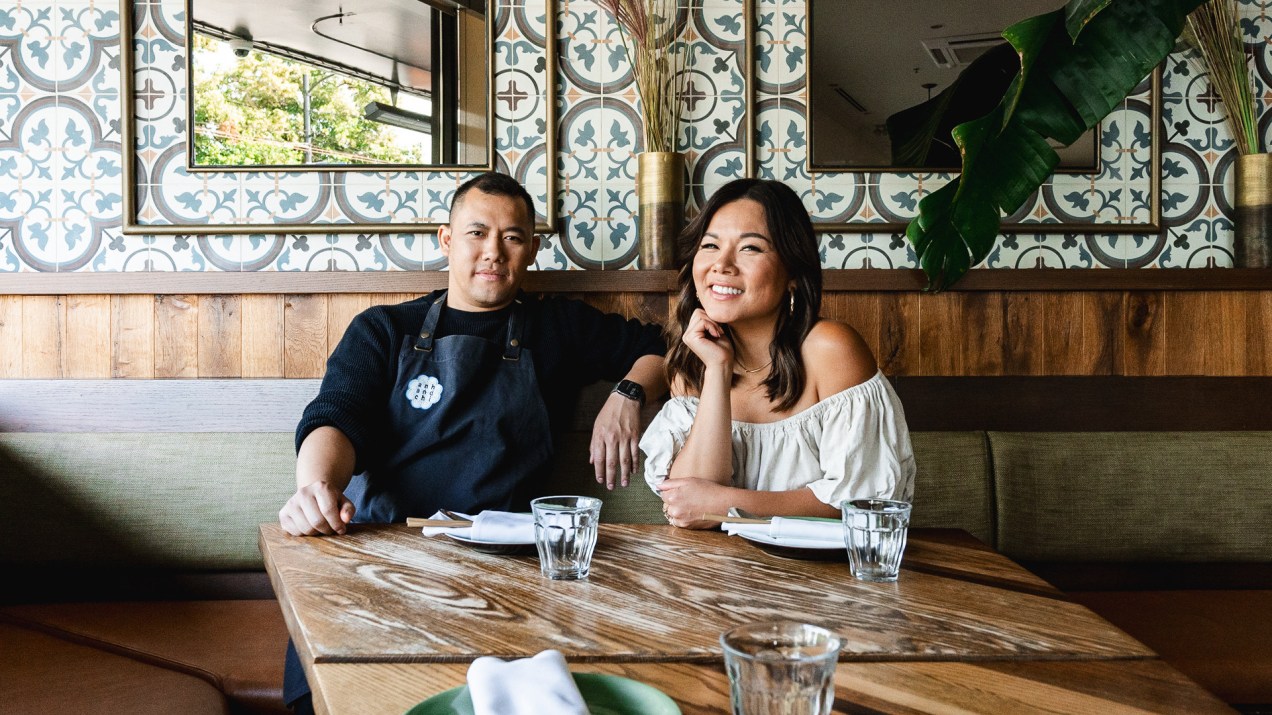
The restaurant’s owners, siblings Amélie and Vincent Nguyễn, opened Anh and Chi (its name translates as “elder brother and sister”) in the space that previously housed their refugee parents’ beloved Pho Hoàng, said to be Vancouver’s first pho specialty restaurant. When family patriarch Hoàng passed away, Amélie and Vincent decided to forego completing their university educations and instead honour their parents’ legacy with a new, modern dining destination. Eight years later, it remains as popular as ever (possibly even more so, after receiving a Bib Gourmand designation from Michelin). Amélie and Vincent’s mother, Lý, retains a crucial role in Anh and Chi’s success as its executive chef; in fact, her own home cooking has always been one of the menu’s primary inspirations.

Most recently, just weeks before the following interview took place, the Nguyễns opened a new venture, Good Thief, in the space next door to Anh and Chi. Like its neighbour, the interior and menu offerings at Good Thief are impeccable. Unlike its neighbour, the concept is more of a lounge, where inventive cocktails are served alongside small, shareable dishes such as fish-sauce-glazed frog legs, and an incomparable version of pommes frite, served with curry leaf and Thai green-chili aioli.  

Yet despite being in the midst of what may be the busiest period of their lives, Amélie and Vincent radiate calm and happiness — the glow of contentment that comes from knowing their hard work is being rewarded by the love and devotion of their community, as well as guests who come from near and far to experience a meal imbued with decades of pan-generational experience, meticulous attention to detail, and, Vincent repeatedly emphasizes, “love.”

This interview has been edited for brevity and clarity.

What’s your earliest memory of being taken to a restaurant?
Amélie: I can’t remember! We grew up very poor, and so we didn’t have the money to go out to eat. My mom and dad, they arrived [in Canada] as refugees in 1980. They used to buy the spines of chickens, because they couldn’t afford the meat. The cheapest part was the discards — the bones, the spine — and they would bring it home and they would braise it or deep-fry it and caramelize it. It was all they could afford, but it had amazing flavour.

But actually, my first childhood memory of a restaurant was the old Pho Hoàng, at Main and 20th. At nighttime — probably 9:00 or 10:00, and I was maybe six or seven years old — I would go with my two cousins, and we would skim the fat that rises to the top of the pho, which would simmer for 20 hours. In order for the pho to be very clear, all of that has to be taken off. We would occasionally scoop out a beef bone and eat the marrow, and it would be so sweet because of the spices and seasonings from the broth. We would dip it into hoisin sauce and my mom’s chili oil.

Were you curious about western food — particularly fast food and whatever you saw the white kids eating at school?
No, I don’t remember that.

You never were intrigued by McDonald’s or anything like that? It must have seemed exotic if you’d never had it.
Eventually we did go to McDonald’s. I remember my mom taking me to the one on Main. There’s still one there now, but it was different. It had a merry-go-round, and I remember eating [McNuggets] and fries, and eating it with honey. My mom introduced me to honey with chicken nuggets!

And I would go with my best friend to Riley Park — the skating rink — and there was a McDonald’s there. We didn’t have money, so we would ask for ketchup and we would eat the ketchup. We said we were “ketchup sisters.”

That’s tragic and adorable.
I know! (laughs)

[At this point, conversation turns to one of Amélie’s uncles, Tom, with whom she closely bonded when she encouraged him to come out as gay to the family. He did so a few months later.]

[Tom] is a restaurateur in Seattle, and now he owns a gay club in Capitol Hill. His restaurant, Tamarind Tree, inspired us to do Anh and Chi. We saw how successful it was, serving authentic Vietnamese food, but making it more elegant and beautiful, and pairing it with cocktails. And because it worked in Seattle, which is very close to Vancouver, we were like, “We can do it here.”

When you were preparing to open Anh and Chi, did you bring in any outside people to develop the menu, or was it just your mom?
My mom, but also my Aunt Mary and Uncle Tom. My aunt actually sacrificed a month of her life, away from her husband and her children, to come live with us in Vancouver.

Also, my mom, my brother, my sister and I, we took a family trip to Vietnam to get inspiration and make sure things would be authentic. We went to the north, where my mom’s home was. I jotted down all the things I ate, whether at a relative’s house or on the street or in a restaurant. Then we went down south to the Mekong Delta, to visit my dad’s side.

So, the inspiration for the menu came from our trip in Vietnam, and also dishes where it was like, “Mom, you make this at home” — like her caramelized fish — “Let’s make it here, too.” But we would use B.C. fish. Like, in the winter, we use Arctic char; recently, we’ve used sablefish. We try to bring in local ingredients that are sustainable, and then we incorporate that into our Vietnamese recipes.

What about, for instance, the plating, or choosing the glassware and the plates? From the very beginning, it was so sophisticated and so unlike what someone expects to see at a Vietnamese restaurant.
That’s all Uncle Tom. That’s all ‘Gay Uncle Tom,’ of course. (laughs) He actually found a source for the [place settings] in Vietnam — this village, an ancient village, and they make ceramics. He ordered so much for his restaurant that he was like, “You know what? You’re opening a restaurant. Just come to our storage locker and take some.” All of the dishes were made in Vietnam and hand painted.

Vincent [oversaw] more of the structural things, like the pipes and the water and the air con, and the stoves and vents.

How quickly did you realize that the success of Anh and Chi was exceeding your expectations? The lineups and the waiting list — those were there from the beginning, right?
Day one. We were blown away. We opened and then we had to close early that day because we ran out of everything. And there was no marketing, no PR. It was our parents’ legacy: The community knew that the children from Pho Hoàng were opening up a restaurant. And all the media outlets, like Vancouver magazine and the CBC, they all reached out to us. We didn’t work with a publicist.

Did you then have to scale up very quickly to meet the demand?
Our team grew. And the beauty was, because we had to scale up — it was great, because there were people who were very ambitious, that wanted to grow into management, and so we were able to grow, too. Part of the responsibility of being a business owner is, you’re growing with your team, and if you want to keep working with them, you have to be able to create a dream big enough to grow with.

[Vincent arrives and Amélie lets him take over the conversation while she tends to a meeting with the Good Thief team.]

How did you end up acquiring the space next door to Anh and Chi? It was a great stroke of luck that it became available.
Vincent: During the pandemic, a lot of places went out of business. Unfortunately, the hair salon and the framing store [that previously occupied the space] also went out of business. We have a great relationship with the landlord for Anh and Chi, so the landlord approached us and said, “Hey, do you want to expand?”

Did you ever contemplate just making it an extension of Anh and Chi?
We did think about it. But, you know, Anh and Chi is already a well-oiled machine, and to mess with that, it would add a bit of headache. I had wanted to create something of my own — my own identity, something that’s not a family-run restaurant.

So, Good Thief is more your project?
Yeah, it totally is. It’s the little brother going against tradition, following no rules, being rebellious.

Was it difficult to sell the idea to the rest of the family?
No, not at all. I think selling the idea of Anh and Chi — “Hey, Mom, I’m dropping out of med school and opening a restaurant!” — that was the hardest thing to do. It finally dawned on her: About four or five years [after opening], she had dinner with me and said, “Hey, you know, I’m proud of you for leaving medical school.”

What was the length of time from acquiring the Good Thief space to opening?
That was about two years. There were a lot of hiccups. Don’t build a restaurant where there’s no existing restaurant. Don’t do that. (laughs) But the benefit is I can be at both places at once. I don’t have to cross a bridge to tend to another restaurant.

There was no point at which you thought, “I’m busy enough already”?
Yeah. But we have to grow. We have an amazing team and they need to grow. And by growing, we can allow opportunities to meet new people, bring in new talent, and also expand.

Was Good Thief inspired by other places, not in Vancouver but elsewhere?
Oh, yeah. New York, L.A., in Japan, in southeast Asia. And that’s the whole idea behind the name Good Thief. It was us going around the world, stealing these ideas — the cocktails, the design, the service — and bringing them back and sharing them with the community.
Standard
Asian Fusion, Fusion, Indonesian Cuisine, Italian, Latin American, Mexican, Middle Eastern Cuisine, West Coast

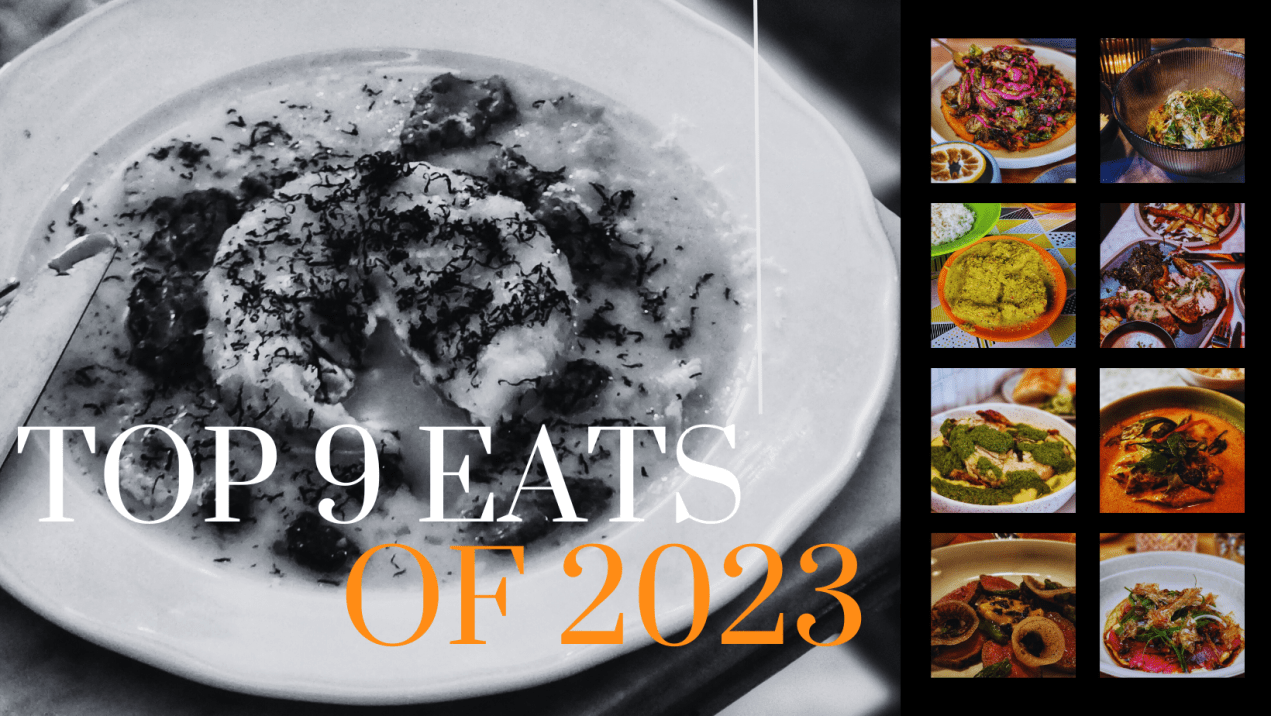
Our Top 9 Eats of 2023

Visit our Instagram page

By Michael White and Kley Klemens
Photos by Kley Klemens

Jewkarta may be only three years old, but we’ve visited a staggering number of restaurants, eaten and guzzled an overwhelmingly vast selection of food and beverages, and made the acquaintance of countless culinary professionals in this short period of time. And we’ve loved every minute of it!

2023 was, by far, our most interesting year yet, for reasons good (Kley’s long-overdue return to his native Indonesia; some of the greatest dining experiences we’ve had as a couple) and not (Michael’s sudden health downturn, which prevented him from participating in most of Jewkarta’s activities for the first half of the year).

But our annual Top 9 is all about emphasizing the positive — specifically, the most delicious and memorable dishes we ate throughout the past 12 months. Scroll down to discover them all. And whether you began following us three years or three minutes ago, we thank you for being a part of our gastronomic adventures in Metro Vancouver and beyond.

@barhaifa
HAIFA HALF CHICKEN

Chicken is often little more than a chef’s compromise for unadventurous customers. But the iteration at this new (and spectacular) Middle Eastern restaurant is one of the best we’ve had, thanks to its secret seasoning blend and a gravy good enough to redeem the foulest of fowls.

@liviasweets
SUNDAY ROAST PORCHETTA FOR TWO

Italy’s beloved pork dish (boneless, with shatteringly crisp skin and infused with the flavour of its own fat) is transcendent at this popular Commercial Drive eatery, its inherent richness amplified by a bed of velvet-soft polenta, and contrasted with the bracing heat and acidity of an emerald salsa verde.

@bar.gobo
ROASTED STRIP LOIN

The ever-changing menu at this edge-of-Chinatown wine bar means this simple yet perfectly executed dish from chef @so_j_one may not return for a long time, if ever. So excuse our conflicting emotions: thrilled that we were able to experience it, sad that we may never again.

@chupitococteleria
TOSTADA DE ATUN

This trailblazing seasonal dining space (located in an alleyway, and open only during warmer months) specializes in elevating familiar Mexican dishes to a state of luxury. We utterly devoured this photogenic tostada, which arrived topped with tuna, ginger mayonnaise, spicy soy sauce and fried katsoubuchi.

@elephantinvancouver
PORK NECK

Are we able to confirm that chef @justin.song.ell is human? His endless creations, which he invariably cooks and plates alone at a small prep station behind Elephant’s diner-like counter, are bizarre in theory yet astounding in reality. Berkshire pork neck flavoured with FIFTY-FOUR different types of Thai herb? Whatever you say, chef!

@zarakvancouver
BRUSSELS SPROUTS

Whoever discovered that the vegetable responsible for ruining countless childhood Thanksgivings could be fully redeemed by a swim in a deep fryer deserves the Nobel Peace Prize. For piling them onto a pool of red-pepper hummus and anointing them with a neon-pink masala sauce that looks like it belongs on a birthday cake, Zarak deserves the MacArthur Genius Grant.

@caffelatana
RAVIOLO

A single plate-sized pasta pillow, stuffed with black truffle, ricotta and herbs. Almost indecently rich and savoury, Kley continues to daydream about it as if it were a millionaire daddy offering to whisk him away to a private resort on the Amalfi Coast.  

Somewhere in North Sumatra, Indonesia (no website)
NANIURA

A highlight of Kley’s visit to his homeland: tilapia ceviche marinated in kafir lime juice mixed with torch ginger (a perennial plant native to Indonesia), turmeric, candlenut, Andaliman pepper, coriander and more. Another reason why Kley is baffled by Indonesian cuisine’s low international profile.

@hujanlocale
ACEHNESE GRILLED OCTOPUS

Another Indonesian dish — created by chef @meyrickwill, who helms the kitchen at this must-visit restaurant in Bali — the complexity of which Kley can’t describe or compare to anything he’d had before. Acidic and spicy, creamy yet light — Kley asks, “How is it that I’m Indonesian and Chef Meyrick isn’t??”

Standard
Asian Fusion, Chinese Cuisine, Taiwanese Cuisine

Review: Jingle Bao

Watch the video review here!

By Michael White

Some of my earliest and fondest food memories are of a Chinese-Canadian restaurant to which my parents would take my brother and I when all of us were much younger than we are now.

Ding Ho — in Hamilton, Ontario — (the name is a phonetic simplification of “ding hao,” roughly meaning “the best”) was emblematic of the sort of Western-style Chinese restaurants that flourished in North America throughout the 1960s and ’70s. The capacious, multi-sectioned dining room was typically bustling with white suburban families, all of us still in thrall to the revelation of what we didn’t yet know was thoroughly inauthentic fare, conceived to push the most vulnerable buttons of our white suburban appetites. It may be a deception of nostalgia or the blur of too many decades, but my recollection is that Ding Ho’s renditions of the dishes that would soon achieve food-court ubiquity — sweet-and-sour chicken balls; garlic spareribs; wonton soup; Cantonese chow mein — were better than any I’ve had since. Everything was better than it needed to be, and the product of a kitchen that knew what it was doing (I saw its doors swing open often enough to know the only non-Chinese faces at Ding Ho belonged to the customers).  

I’ve come to think of Jingle Bao — which opened in late 2019, at the northern edge of Denman Street where the West End bleeds into Coal Harbour — as a 21st-century notion of what made Ding Ho and its ilk so groundbreaking (and so addictive) half a century ago. I mean this as a compliment. Its goal is to take what was once somewhat exotic and refashion it — via clever branding, a gimmick or two, and unabashed deliciousness — for a new mass audience. I wouldn’t be surprised if its owners have global expansion in mind.

Jingle Bao’s menu isn’t as breathtakingly all-encompassing as those that once were standard (and, in some places, still are) at the Western Chinese restaurants of old, but variety is a large part of the objective. There are more than 65 items here, divided between categories including Appetizers, Dumplings, Dim Sum (many of which could pass as Appetizers), Main Dish, Soup, and Rice.

But Jingle Bao’s marquee offering, it won’t surprise you to learn, is bao. This, however, isn’t referring to the steamed-bun sandwiches you might be familiar with from Vancouver mainstays like Bao Down and Heritage Asian Eatery, but to xiao long bao (or XLB), better known in this part of the world as soup dumplings. Conceptually simple yet painstaking to prepare, each multi-pleated dumpling is filled with pork, beef, seafood or vegetables, and a piping-hot broth that bursts forth when its dough encasement is punctured by your bite. (Eating them is itself something of an art form.)

Jingle Bao drew attention from the moment it opened its doors for what it calls “rainbow” xiao long bao ($9 for five, or $11 for the “magnificent seven”): an assortment of dumplings, most featuring a Crayola-bright skin (apparently the result of all-natural colouring agents), and each with a different filling, such as pork, prawn, mushroom, and spinach. The mark of an exemplary bao is a thin, virtually translucent skin that yields to the merest intrusion of a tooth. Jingle Bao’s dumplings are relatively sturdy, which may lead purists to dismiss them out of hand, but their flavours are very good and they stand up well to reheating at home — a serious plus in these takeout-centric times. True to its name, the “Supersize” xiao long bao ($8) is a single dumpling that fills an entire steamer basket, its skin already pierced when it arrives with a squeezable syringe of Zhenjiang vinegar (a soup dumpling’s traditional dipping accompaniment) and a straw through which you drink the broth.

Does this smack of novelty? Yes. Is that the point? Absolutely. Jingle Bao’s management has acknowledged its bao are ideal for Instagram, and the hundreds of posts thus far (in a year when restaurant traffic has been cut off at the knees) suggest the public is indeed amused.

Equally photographable and almost as outrageous is Crispy Snowflake Dumplings ($11), a half dozen gyoza-style dumplings (filled with pork, beef, chicken, fish or vegetables) conjoined by their pan-crisped exteriors, decorated with chili mayo and a showering of scallions and edible flowers. It beautifully, shamelessly exemplifies what a friend once described to me as “slutty food” — a dish whose existence is predicated solely upon appealing to your most primal cravings. These dumplings have it all, or as near to it all that it makes no difference: crunch, chew, salt, spice, a hint of herbaceousness, colour…. It reminds me of nothing so much as Taco Bell’s peerlessly slutty Fries Supreme. Again, I mean this as a compliment.

If none of the above piques your interest, you must have an aversion to fun. But you should also know that Jingle Bao offers familiar comforts by the dozen, including four types of fried rice ($14 each), steaming bowls of noodle soup ($9 to $14), and classic “Which decade is this?” menu warhorses such as orange chicken ($13), sliced beef with seasonal greens ($14), and — gasp! — BBQ pork chow mein ($14)! Vegetarians, for a change, will also be spoiled for choice.

Everything is very pretty. Everything is very happy-making, in the way that affordable, approachable restaurants such as these always purport is their aim but all too rarely deliver.

Jingle Bao
774 Denman St.
604-428-7722
jinglebao.com / Instagram: @jinglebao_restaurant
Delivery platforms: Ritual, Skip the Dishes, Uber Eats

(Photo: Kley Klemens)  

Standard