Belgian, Casual

InterJew #11: Nico Schuermans (chef, Chambar)

Visit our Instagram page

By Michael White

While he tries repeatedly, throughout an hour-long conversation, to deflect any suggestion that his accomplishments as a chef and restaurateur are exceptional, many of us can’t imagine Vancouver’s dining scene had Chef Nico Schuermans not moved here and opened Chambar in collaboration with his then-wife, Karri Green-Schuermans (who remains its principal owner).

Although Chambar has always been deservedly acclaimed for its food (much of the menu is a reflection of Nico’s Belgian heritage), it may be just as notable for serving as an incubator to many talented people who subsequently opened successful restaurants and other businesses of their own — among them past InterJew interviewees Robbie Kane (owner of Café Medina) and Kelcie Jones (Michelin’s 2023 Vancouver Sommelier of the Year). Think of Chambar as a benign octopus whose tentacles now embrace much of the city’s restaurant landscape, in ways both obvious and subtle.

At the time of this writing, in September 2024, Chambar is celebrating its 20th anniversary with a series of special events. Despite not being an especially public person (his response to people who suggest he should have a personal Instagram account: “For who? Anyone I care about, I see them every day”), Nico spoke enthusiastically and at length about a restaurant and a career that have far exceeded his expectations.

This interview has been edited for brevity and clarity.

What’s your earliest memory of being taken to a restaurant?
It was with my grandfather. He was a [military] reserve, not a career soldier. But in Belgium, if you get into the army, you become an officer. He was an officer, although he was a lawyer by trade. You would have these restaurants — they’re like a private club for officers — and I remember him taking me. I was probably eight or nine. There were round tables, napkins, very formal. That was the first time I experienced a high-end kind of restaurant.

What did they serve there?
Very traditional. It would have been coq au vin, stuff like that. But I knew that him taking us there was a big deal. This would’ve been the mid-’80s.

Prior to Vancouver, you had a fairly nomadic career. You were in Belgium, you were in London, you were in Australia. What brought you here?
This is actually not a joke: Every travel I did was following a girl. I went from Belgium to London because my girlfriend had an au pair job in England, and I really wanted to go to London, [where I got a job at] the Savoy. I went to Australia, following a French girl who was going there. And then from Australia, I followed Karri: We came to Canada for ski season. We never planned on staying. Karri loves skiing, I love skiing. Karri is Canadian, so we decided to come here. We got married on the way and I fell in love with Canada.

What did you hope Chambar could bring to Vancouver’s dining scene that wasn’t already here?
I felt in Australia that food was a little bit boring because of the [lack of distinct] seasons. Growing up in Belgium, the seasons are very exciting for a cook. They give you structure; you know what’s coming next and you always have something to look forward to.

But I also realized that Vancouver, for a city — compared to New York or Sydney — it was really not there yet. There was Le Crocodile — great food. Cactus Club. And there was Lumière, which was high-end; great food, but pretty stuffy, you know? My favourite restaurant was Bin 941. That was the kind of the food I was interested in: very technical, good flavours, but you didn’t have the stuffiness. [Writer’s note: Bin 941 was a very popular, very narrow restaurant in the West End, known for its creative small-plates dishes and extremely loud music. It closed in 2018.] I was looking for work, and I really struggled because I couldn’t find a person I wanted to work for. And I was still young — 25 years old — so I needed to learn. I started cooking when I was 14, so I still had a lot of experience, but I didn’t want to be a head chef, because I’d been a head chef in Australia and I found that I was running things more than cooking, and I already knew that was not something I was into.

I did, like, seven years in three Michelin-star restaurants. There was a lot to learn from it, but it didn’t match my personality. When I was 16, I wanted my parents to experience what I was doing, but it was out of reach for them. The price was too high; it was not their world. I wanted Chambar to be a place where everybody would feel welcome. I remember the first time I realized I had succeeded, about six months after opening the first location. I think it was the first time I’d stepped out of the kitchen for a whole evening, and I decided to sit at the bar with a friend of mine. I looked around the room and I saw every demographic I wanted to cook for. This is what I wanted.

I moved to Vancouver in 1999, and Chambar was the first new restaurant here whose opening I realized was being treated like an event. I think the first episode I saw of [Food Network Canada’s] Opening Soon was about Chambar. And I also remember that much of the attention being given to the opening was because of the location you chose, which at that time was considered a sort of a no-man’s land — there wasn’t really anything else on that block. Were you nervous about staking this very important venture of yours on a neighbourhood that people weren’t used to going to?
I didn’t know the city well enough. I was living on Commercial Drive and working in Kits. I wasn’t really aware of the problems of Vancouver… But Karri, she did her homework, and she knew that all those [condo] towers were getting built nearby. She said, “We’re going to have 2,500 new condos in this location in five years.”

But what we didn’t know about was hockey. We didn’t think the stadium [Rogers Arena] was gonna be such a draw for us. One night there was a Sting concert, and that night we went from doing 100, 120, 130 people one evening, to a line-up before 7:00 p.m. We got buried. It was a Saturday night and I shut down the kitchen by 9:00. We had no food left. And I remember coming back on Sunday, and I sat in the kitchen, thinking, “How are we gonna do this right?” I thought that we had an 80-seat restaurant. I didn’t know that Vancouver had three seatings, so the 80 seats turned into 160 real quick, and then we broke the 200-seat [threshold].

Did the Opening Soon episode have a lot to do with that?
It was huge. You know, seven years after that show, I met these Dutch people in the dining room, and they were saying that the reason why they came here — not to Vancouver, but to Chambar, while they were visiting — was because the Food Network sold the rights to the show in Holland, and they saw us. We had people from all over Canada coming to see us. It was a really well done show, and it represented us really well.

Two other people I’ve interviewed for this series, Robbie and Kelcie — they both said something very similar, which was that, number one, Chambar was where they learned more about the industry than anywhere else, and also that what was so great about their experience here is they were allowed to make mistakes, because in the process of making mistakes, you learn, and then you’re able to move on and either work elsewhere or do your own thing. Was that a conscious decision of yours, that you wanted Chambar to be a place where your staff could learn the industry better?
Well, Kelcie and Robbie, both of them — those are the talents you need. And once you give them a job, you’ve gotta let them run it. You can’t micro-manage or go after them when they make a mistake. We all make mistakes. I made some terrible decisions in the past. Mistakes are the best thing can happen to anyone. Now, if you make a mistake because of a lack of trying, that’s a problem. But talented people, let them try.

One of my old cooks, a friend of mine, Pat Hennessey — he owns Barbara — he told me years ago that we are the most generous and most demanding owners he ever worked for. And I actually don’t mind that. I’m like that with my cooks, and I’m like that with my kids, too. Like, “I’m gonna give you the best life, but these are the rules you can’t break.” When people ask me why Chambar is so successful, it’s because we surrounded ourselves with talent. Anything I can’t do, somebody has got to do it, and it has to be the best person.

Do you think you have a particular talent for recognizing potential in people? Robbie began as a server and look at everything he’s accomplished.
I think talent attracts talent. Talent is mutual respect. For me, I would never work for people I don’t respect.

Chambar is 20 years old this month [September 2024]. What are you proudest of?
Seeing the impact we’ve had on people — including staff, even more than customers, because I’m not that in contact with customers. Knowing I was able to allow people to learn and do their job and create a career out of a place like this, it’s more like I look back and I know how much people are touched. I have a dishwasher who worked for me for years. He ended up being able to buy a house in Langley. I’m very proud to be able to create an organization that allows people to do that.

(Photo: Jenna Low)

Standard
Asian Fusion, Casual

Review: Meo

Visit our Instagram page to see more photos

By Michael White

To restaurant patrons of a certain age (and here I mean myself and my Generation X peers), there are few sights in a restaurant as unexpected — and as immediately nostalgia-inducing — as carpet.

Throughout the 1970s and well into the ’80s, carpet was the default floor covering of almost any restaurant whose parking lot wasn’t bathed in the neon glow of an illustrated hamburger. Pizza Hut was carpeted, and literally every Chinese joint, and so was “the good steakhouse” where your parents celebrated special occasions without you. But then, for whatever reason, carpet fell sharply out of favour — in both commercial and residential interiors — to be replaced with hardwood, laminate or poured concrete. And restaurants were never quiet again.

Meo, in Vancouver’s Chinatown, is filled with carpet, from the raised dining section at the back of the room to the entire width of the staircase leading downstairs to the toilets. The carpet’s dominant crimson hue is marbled with beige, like a premium ribeye served at that same steakhouse your parents knew was too sophisticated for your loud, obnoxious, prepubescent mouth. This may seem too minor a detail to be occupying the first three paragraphs of a restaurant review, but it telegraphs Meo’s concept as clearly as anything else about it.

Like its upstairs neighbour, Kissa Tanto (both of which are under the ownership of restaurateur Tannis Ling, and chefs Joël Watanabe and Alain Chow; they also co-own Bao Bei), Meo is serious about its food, drink and atmosphere, but playful about it, too; as exacting about what it serves as the time and place it means to evoke. The cocktail list includes an irreverent version of a Grasshopper, for God’s sake — a cocktail that hasn’t been popular since cars came factory-equipped with an 8-track player.   

“Irreverent” is a key word here, which is why Meo’s proprietors clearly spent a fortune to make it look like a perfectly preserved adults-only lounge from the era when the Mr. Trudeau governing Canada was the one who has now been dead for almost a quarter century. (It came as no surprise that it’s the work of Ste. Marie, Vancouver’s cleverest and, it often seems, most ubiquitous interior-design firm.)  A new restaurant would never purposely look like this in 2024 unless it meant to make you laugh in disbelief.

And laugh we did. But we also smiled contentedly, and exclaimed enthusiastically about a succession of drinks and shareable plates that straddle past and present like Bruce Springsteen’s setlist.  

Mind you, we laughed (amusedly, not derisively) at some of the food, too. How else is anyone meant to react to croquetas filled with Caesar salad? And not authentic, fine-dining-calibre Caesar salad, but chicken Caesar salad, which most of us tend to associate with a sad office lunch in a plastic clamshell bought hastily at Safeway. But they were great, their crisp breaded exterior stuffed also with an incongruous Béchamel sauce. I wanted another order.

But there were too many other dishes to try, including the ethnic collision that was a Japanese-style milk bun filled with curried potato, which we were instructed to tear into pieces and spread with dabs of apple butter. Sure, why not?

Yukhoe, the Korean equivalent of tartare, was also highly memorable. Neither Kley nor I can ever get enough of a tartare, and this one — garnished with Nashi pear and nori alongside the expected cornichons, capers and egg yolk — looked as if it had too many elements to cohere, but somehow it was a success. The shards of semolina cracker we scooped the beef onto were both shatteringly crisp and appealingly dense. Our only criticism is there weren’t enough of them.

But the evening’s showstopper — and this seems to be happening more and more recently — was a burger. Specifically, what the menu describes as a beef bourguignon burger. Frankly, I couldn’t detect an obvious similarity to the eponymous French stew (and I’d have preferred half as much salt, although Kley’s Indonesian taste buds had zero complaints), but I still devoured it like the highbrow trash it means to be.

Cocktails are similarly mischievous in terms of how they defy expectation. I was forewarned that the Old Fashioned I ordered has proved divisive among customers because it doesn’t taste much like an Old Fashioned. And it doesn’t, but this is exactly why I enjoyed it; its chocolate bitters, splash of rum and — wait for it! — “duck fat wash” cancelled out the inherent sweetness of the conventional version, which I’ve always thought excessive. Kley opted for one of Meo’s own creations, called Sinful Blossom, which comes in a stubby bottle and somehow makes gin, port, rosé, salted plum and Osmanthus tea seem like they were always meant to be together.

Among the many ways Meo harks back to a long-gone point in history — it even has a vintage jukebox, albeit purely decorative (please do something about this!) — it feels reminiscent of the post-war period when adults who took themselves out for a night on the town actually acted like adults. Between its dim lighting, plush seats, and casual yet deferential service, Meo, above all else, feels very civilized, which can’t be said about most things in the 21st century. Must be the carpeting.

Meo
265 E. Pender St.
604-559-6181
meochinatown.com / Instagram: @meochinatown

(Photo: Kley Klemens)

Standard
Asian Fusion, Casual, Vietnamese

InterJew #10: Amélie and Vincent Nguyễn (owners; Anh and Chi, Good Thief)

Visit our Instagram page

By Michael White

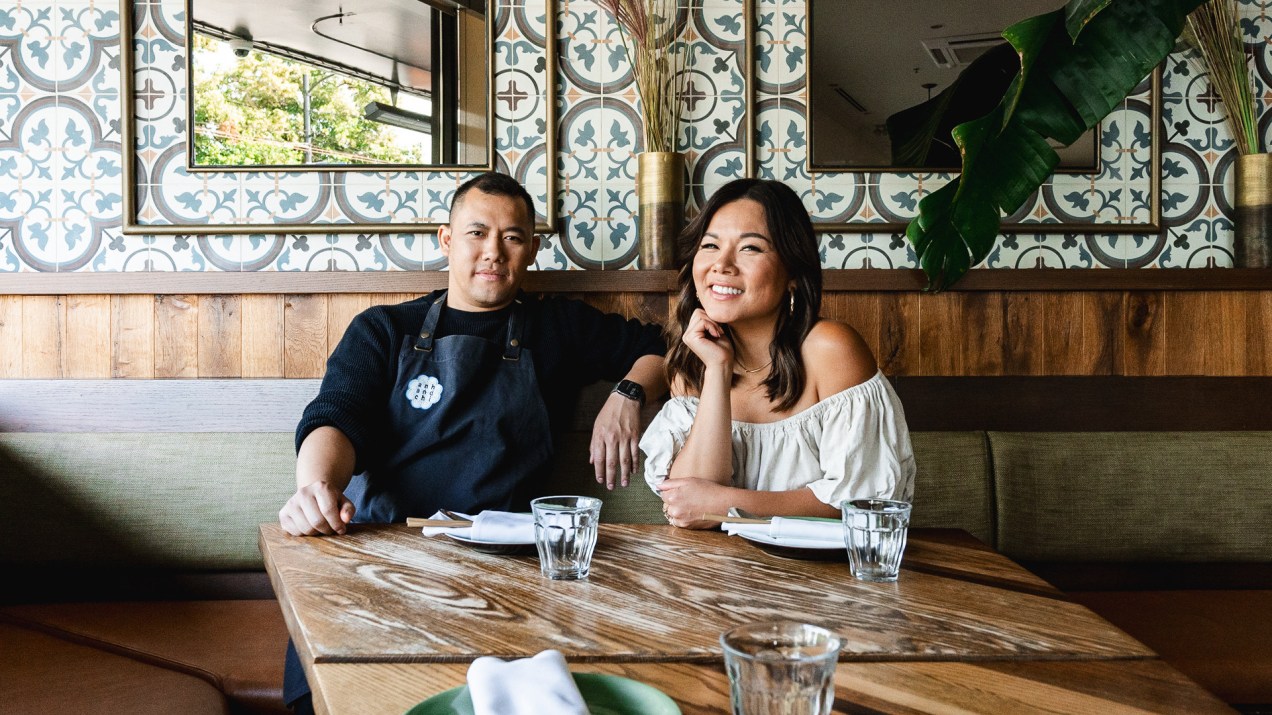
Anh and Chi is one of Metro Vancouver’s greatest restaurant success stories of the past decade. Since day one, in 2016, its authentic yet elevated interpretation of traditional Vietnamese cuisine has proved so popular, it looks strange for there to not be a lineup extending past its Main Street storefront.

The restaurant’s owners, siblings Amélie and Vincent Nguyễn, opened Anh and Chi (its name translates as “elder brother and sister”) in the space that previously housed their refugee parents’ beloved Pho Hoàng, said to be Vancouver’s first pho specialty restaurant. When family patriarch Hoàng passed away, Amélie and Vincent decided to forego completing their university educations and instead honour their parents’ legacy with a new, modern dining destination. Eight years later, it remains as popular as ever (possibly even more so, after receiving a Bib Gourmand designation from Michelin). Amélie and Vincent’s mother, Lý, retains a crucial role in Anh and Chi’s success as its executive chef; in fact, her own home cooking has always been one of the menu’s primary inspirations.

Most recently, just weeks before the following interview took place, the Nguyễns opened a new venture, Good Thief, in the space next door to Anh and Chi. Like its neighbour, the interior and menu offerings at Good Thief are impeccable. Unlike its neighbour, the concept is more of a lounge, where inventive cocktails are served alongside small, shareable dishes such as fish-sauce-glazed frog legs, and an incomparable version of pommes frite, served with curry leaf and Thai green-chili aioli.  

Yet despite being in the midst of what may be the busiest period of their lives, Amélie and Vincent radiate calm and happiness — the glow of contentment that comes from knowing their hard work is being rewarded by the love and devotion of their community, as well as guests who come from near and far to experience a meal imbued with decades of pan-generational experience, meticulous attention to detail, and, Vincent repeatedly emphasizes, “love.”

This interview has been edited for brevity and clarity.

What’s your earliest memory of being taken to a restaurant?
Amélie: I can’t remember! We grew up very poor, and so we didn’t have the money to go out to eat. My mom and dad, they arrived [in Canada] as refugees in 1980. They used to buy the spines of chickens, because they couldn’t afford the meat. The cheapest part was the discards — the bones, the spine — and they would bring it home and they would braise it or deep-fry it and caramelize it. It was all they could afford, but it had amazing flavour.

But actually, my first childhood memory of a restaurant was the old Pho Hoàng, at Main and 20th. At nighttime — probably 9:00 or 10:00, and I was maybe six or seven years old — I would go with my two cousins, and we would skim the fat that rises to the top of the pho, which would simmer for 20 hours. In order for the pho to be very clear, all of that has to be taken off. We would occasionally scoop out a beef bone and eat the marrow, and it would be so sweet because of the spices and seasonings from the broth. We would dip it into hoisin sauce and my mom’s chili oil.

Were you curious about western food — particularly fast food and whatever you saw the white kids eating at school?
No, I don’t remember that.

You never were intrigued by McDonald’s or anything like that? It must have seemed exotic if you’d never had it.
Eventually we did go to McDonald’s. I remember my mom taking me to the one on Main. There’s still one there now, but it was different. It had a merry-go-round, and I remember eating [McNuggets] and fries, and eating it with honey. My mom introduced me to honey with chicken nuggets!

And I would go with my best friend to Riley Park — the skating rink — and there was a McDonald’s there. We didn’t have money, so we would ask for ketchup and we would eat the ketchup. We said we were “ketchup sisters.”

That’s tragic and adorable.
I know! (laughs)

[At this point, conversation turns to one of Amélie’s uncles, Tom, with whom she closely bonded when she encouraged him to come out as gay to the family. He did so a few months later.]

[Tom] is a restaurateur in Seattle, and now he owns a gay club in Capitol Hill. His restaurant, Tamarind Tree, inspired us to do Anh and Chi. We saw how successful it was, serving authentic Vietnamese food, but making it more elegant and beautiful, and pairing it with cocktails. And because it worked in Seattle, which is very close to Vancouver, we were like, “We can do it here.”

When you were preparing to open Anh and Chi, did you bring in any outside people to develop the menu, or was it just your mom?
My mom, but also my Aunt Mary and Uncle Tom. My aunt actually sacrificed a month of her life, away from her husband and her children, to come live with us in Vancouver.

Also, my mom, my brother, my sister and I, we took a family trip to Vietnam to get inspiration and make sure things would be authentic. We went to the north, where my mom’s home was. I jotted down all the things I ate, whether at a relative’s house or on the street or in a restaurant. Then we went down south to the Mekong Delta, to visit my dad’s side.

So, the inspiration for the menu came from our trip in Vietnam, and also dishes where it was like, “Mom, you make this at home” — like her caramelized fish — “Let’s make it here, too.” But we would use B.C. fish. Like, in the winter, we use Arctic char; recently, we’ve used sablefish. We try to bring in local ingredients that are sustainable, and then we incorporate that into our Vietnamese recipes.

What about, for instance, the plating, or choosing the glassware and the plates? From the very beginning, it was so sophisticated and so unlike what someone expects to see at a Vietnamese restaurant.
That’s all Uncle Tom. That’s all ‘Gay Uncle Tom,’ of course. (laughs) He actually found a source for the [place settings] in Vietnam — this village, an ancient village, and they make ceramics. He ordered so much for his restaurant that he was like, “You know what? You’re opening a restaurant. Just come to our storage locker and take some.” All of the dishes were made in Vietnam and hand painted.

Vincent [oversaw] more of the structural things, like the pipes and the water and the air con, and the stoves and vents.

How quickly did you realize that the success of Anh and Chi was exceeding your expectations? The lineups and the waiting list — those were there from the beginning, right?
Day one. We were blown away. We opened and then we had to close early that day because we ran out of everything. And there was no marketing, no PR. It was our parents’ legacy: The community knew that the children from Pho Hoàng were opening up a restaurant. And all the media outlets, like Vancouver magazine and the CBC, they all reached out to us. We didn’t work with a publicist.

Did you then have to scale up very quickly to meet the demand?
Our team grew. And the beauty was, because we had to scale up — it was great, because there were people who were very ambitious, that wanted to grow into management, and so we were able to grow, too. Part of the responsibility of being a business owner is, you’re growing with your team, and if you want to keep working with them, you have to be able to create a dream big enough to grow with.

[Vincent arrives and Amélie lets him take over the conversation while she tends to a meeting with the Good Thief team.]

How did you end up acquiring the space next door to Anh and Chi? It was a great stroke of luck that it became available.
Vincent: During the pandemic, a lot of places went out of business. Unfortunately, the hair salon and the framing store [that previously occupied the space] also went out of business. We have a great relationship with the landlord for Anh and Chi, so the landlord approached us and said, “Hey, do you want to expand?”

Did you ever contemplate just making it an extension of Anh and Chi?
We did think about it. But, you know, Anh and Chi is already a well-oiled machine, and to mess with that, it would add a bit of headache. I had wanted to create something of my own — my own identity, something that’s not a family-run restaurant.

So, Good Thief is more your project?
Yeah, it totally is. It’s the little brother going against tradition, following no rules, being rebellious.

Was it difficult to sell the idea to the rest of the family?
No, not at all. I think selling the idea of Anh and Chi — “Hey, Mom, I’m dropping out of med school and opening a restaurant!” — that was the hardest thing to do. It finally dawned on her: About four or five years [after opening], she had dinner with me and said, “Hey, you know, I’m proud of you for leaving medical school.”

What was the length of time from acquiring the Good Thief space to opening?
That was about two years. There were a lot of hiccups. Don’t build a restaurant where there’s no existing restaurant. Don’t do that. (laughs) But the benefit is I can be at both places at once. I don’t have to cross a bridge to tend to another restaurant.

There was no point at which you thought, “I’m busy enough already”?
Yeah. But we have to grow. We have an amazing team and they need to grow. And by growing, we can allow opportunities to meet new people, bring in new talent, and also expand.

Was Good Thief inspired by other places, not in Vancouver but elsewhere?
Oh, yeah. New York, L.A., in Japan, in southeast Asia. And that’s the whole idea behind the name Good Thief. It was us going around the world, stealing these ideas — the cocktails, the design, the service — and bringing them back and sharing them with the community.

Standard
American, Canadian, Casual, Southern

InterJew #7: Doug Stephen (co-owner; DownLow Chicken Shack, Vennie’s Sub Shop, and The Drive Canteen)

Visit our Instagram page

By Michael White

Much like another recent InterJew interviewee, Claire from Livia, Doug Stephen is a former Torontonian who found his true home in Vancouver, and the Commercial Drive neighbourhood in particular.

Doug met his wife, Lindsey Mann, when they both were working at the Drive’s now-defunct Merchant’s Oyster Bar (Doug was a co-owner). The couple now co-owns three beloved Drive businesses: the astoundingly successful DownLow Chicken Shack, Vennie’s Sub Shop, and The Drive Canteen, the latter a meticulously curated convenience store best known for stocking one of Vancouver’s largest selections of faux-alcoholic zero-proof beverages. Each business is, to varying degrees, autobiographical, inspired by Doug’s favourite childhood foods.

This interview has been edited for brevity and clarity.

What’s your earliest memory of being taken to a restaurant?
There was a place in Toronto called the Organ Grinder. It was kind of like the very first iteration of an arcade in conjunction with a solid pizza program. Imagine Chuck E. Cheese but without the scary animals. and instead with a higher level of food. I can’t remember whether it was my birthday party or somebody else’s, but the idea of a dining experience that included this whole multimedia sensory situation was pretty popular.

Are you originally from Toronto?
Born in Winnipeg, raised in Toronto my entire life, and then the first go-round in Vancouver was 2005 and 2006, and then the second go-round in 2010.

What compelled you to move to Vancouver and why did it take a couple of tries to stick?
Both times I was following my heart with regards to a partner at the time, as well as a desire for a change of scenery. It stuck the second time around because I ended up being both a dog owner — a pit bull, which was banned from my other home provinces — and I was a business owner, so suddenly I didn’t have a choice but to remain in B.C., and very happily so. I very much love the west coast — the lifestyle and being close to nature.

I was working at a place in Gastown called Cork & Fin, and my boss at the time asked me if I’d like to become partners in his next venture, which was on Commercial Drive, called Merchant’s Oyster Bar. I jumped at the opportunity, because being a restaurant owner has always been something I wanted to do. It was our second day of [soft opening], and somebody who’s now a dear friend turned to me and said, “The most important part about being on the Drive is taking care of the locals.”

I was living in Toronto in 2003 and ’04, around the time of the SARS[-CoV-1 virus]. I was working two jobs at the time, one of which was driven by tourism and the businesspeople who were coming downtown, and the other was entirely neighbourhood focused. The first business lost everything, because suddenly people weren’t coming to the office and there was no tourism, and the other one flourishedbecause the neighbours wanted to take care of their neighbourhood space. So, hearing my pal, Sarah, say, “Take care of your neighbours and they will take care of you” resonated on a number of levels. I love all of Vancouver, but I’ve felt most at home on the Drive, where the idea of saying hello to your neighbour — whether you know them or not — as you walk down the street is not treated in such a weird way as it might in some other neighbourhoods.

How important was your tenure at Merchant’s in terms of teaching you how to be a restaurant owner?
I think that every experience I’ve ever had has been a learning opportunity — some of them in terms of what to do and some in terms of what not to do. With Merchant’s, it was my first opportunity at ownership. It was an overreaching space and I understand now that there was more that I didn’t know than I did know. And that led to Lindsey and I really rethinking how we wanted to do things when it came time for Downlow. We started with the idea that our lifestyle with Merchant’s was not sustainable for anybody, and the resulting challenges — looking back at it and who I was, I wasn’t happy. And so we wanted to change this life for ourselves. We started with the idea of trying to remove a lot of the challenges that we felt with Merchant’s. It’s been really positive. There are still stumbling blocks and there’s still so much learning for us to do, but I’m really happy with what we’ve been able to build.

How was the lifestyle at Merchant’s unsustainable?
I was an alcoholic, and part of it was self-medicating to deal with the stress, the anxiety, the rush of service and getting through a 16-hour day. It wasn’t until a few years after we opened Downlow that I really started to see the impacts it was having on me. I wasn’t participating in some of the more difficult challenges our industry presents, but it was still enough that I wasn’t happy with who I was. Sobriety, for me, has been a really, really positive change.

It’s interesting that you were able to initiate that lifestyle change when you were at Downlow, because from the very first day, it was busier than Merchant’s had ever been, wasn’t it?
Yup. There were still incredibly long days, but they were very different and they were very… I don’t wanna say fulfilling, but it was a very different space and it was very different in the way that it operated. The daytime versus the late nights, the liquor license versus no liquor license — all of these things amounted to this dramatic shift in lifestyle for me.

How surprising was it that Downlow was so popular from the beginning? I’m sure you were optimistic and you had reasonably positive expectations, but it was a juggernaut from day one.
We were incredibly surprised, and then we also were petrified about being able to maintain expectations, especially because the hype just continued to grow. We try, every single day, to be better today than we were yesterday, and to make sure that tomorrow we’re gonna be better than today. I feel so, so lucky that we were received the way we were, and I also feel very blessed that this is what I do for a living. I get to revisit the foods of my childhood and do them through a slightly better lens and use [higher-quality] proteins. And more importantly for Lindsey and I, we get to try to shift the conversation within our industry in terms of how we take care of the people around us — because, to be honest, we’re nothing without them.  

You said in an interview with the Vancouver Sun that a lot of the foods you like cooking most are based in nostalgia. So, how does fried chicken figure within that context? What makes it so nostalgic for you?
Chicken fingers. (laughs)

From anywhere in particular?
Yes and no. I’ve always been somebody who just genuinely enjoys the product. I probably don’t eat KFC nearly as much as I used to. To be honest, it’s only if they release a new product that I go to check it out. But I still get the cravings for that neon-green coleslaw. I was talking about the Organ Grinder: They had a freaking bangin’ garlic-cheesy bread and, surprisingly, what really evokes that memory for me is Pepino’s. Dramatically different, significantly higher-quality bread at Pepino’s. But holy moly, does food ever bring back a lot of positive memories for me. So many positive moments in my life have been shared at a table, and I think that’s why nostalgic food is so key to me.

As a former Ontarian myself, I have to ask: Was Vennie’s inspired by Mr. Sub [an Ontario institution that opened its first location in Toronto in 1968]?
I call it “east coast sandwich culture.” There are elements of Mr. Sub, and also of St. Lawrence Market [in Toronto], and having experienced Jewish delis in New York. When we launched Vennie’s, the few places in Vancouver that I thought were really paying homage to this east coast thing — none of them were really open. Say Hey had closed and it didn’t look like it was coming back, and La Grotta had closed for renovations, if I’m not mistaken. We had originally taken on the Vennie’s space so that we could store enough chicken to operate Downlow, so we were carrying this second lease and we thought, “If we can at least contribute some of the lease value, it’ll be better than nothing.” That’s what Vennie’s was born out of, and it’s kind of taken on a life of its own. We’ve recently been doing some renos there to increase seating and make it a more hospitable space, instead of this kind of pseudo construction zone.

I just love [sandwiches]; I love what you can do between two pieces of bread. I love anything I can hold in my hand. Don’t get me wrong — cutlery is great. But if I can just pick it up and crush it, I’m stoked. 

Which do you think is the most underrated restaurant in Metro Vancouver?
I think what Justin [Song-Ell, chef] is doing at Elephant… I’m just a huge fan of his, of his cooking and his food. And I know he’s getting recognition, but I just wanna scream it from the rafters.

Standard