
Visit our Instagram page
Abdallah El Chami (you can call him Dallah) spent years working in the tech sector. But his mind was often elsewhere: specifically, in the world of restaurants, which so fascinated him that, while studying at university, he sketched a floorplan of an idealized establishment that would serve the cuisine of his native Middle East.
Eventually, the restaurant industry came to him, when the principals of Café Medina and Tacofino took interest in the food he was serving at various pop-ups in and around Vancouver. The result was Superbaba, which opened its first location in Victoria, in the summer of 2017. Vancouver followed, first as a food truck, then, in late 2020, as a bricks-and-mortar space.
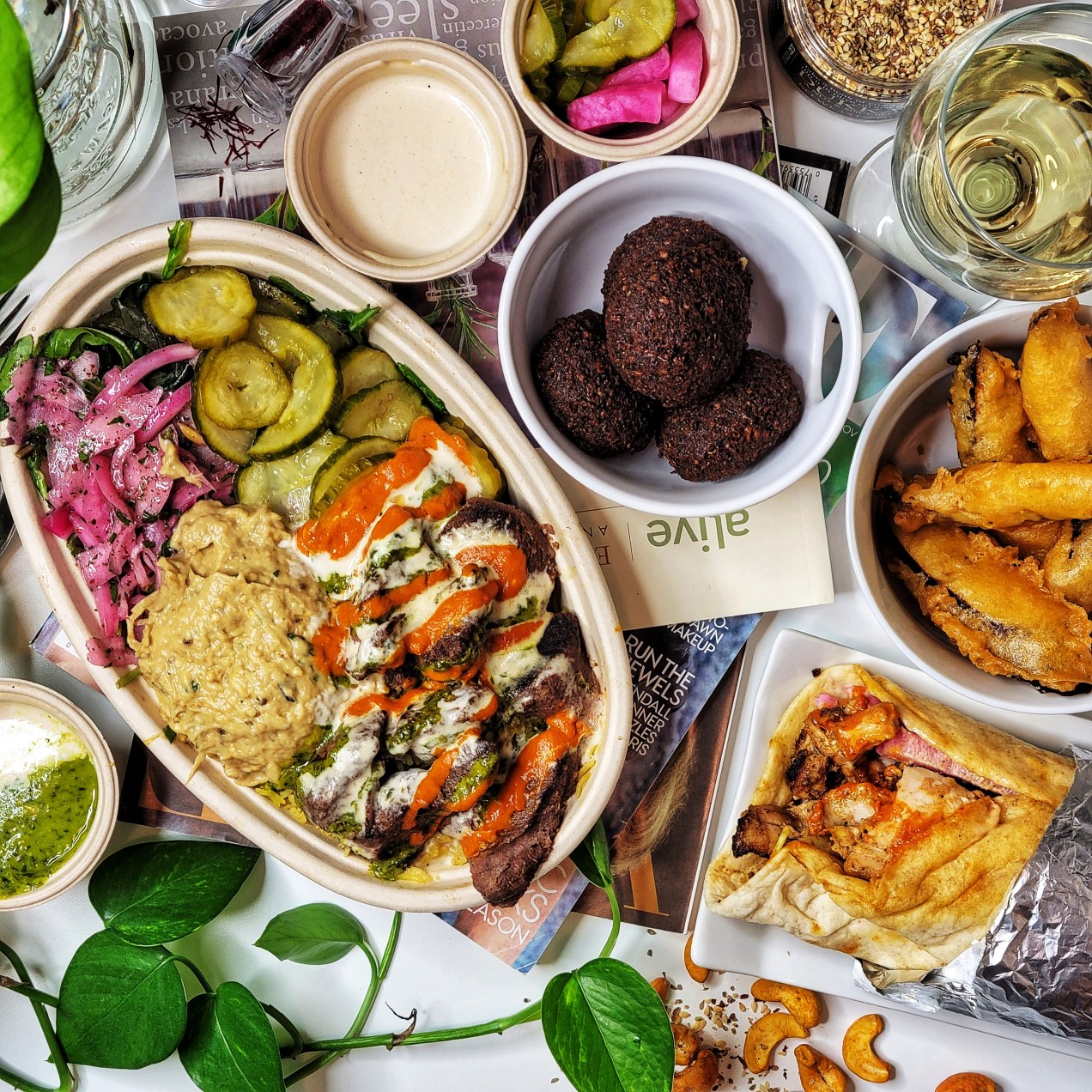
It isn’t hyperbole to say Superbaba set a new standard in the region for casual Middle Eastern cuisine — an assertion supported by rave reviews and multiple awards. And just days before the conversation that follows, Dallah’s Midas touch proved itself again with the opening of Mishmish, a Middle Eastern-themed bakery and café that immediately generated ecstatic word of mouth.
This interview has been edited for brevity and clarity.
What’s your earliest memory of being taken to a restaurant?
Oh, geez. That’s a hard one to remember. My family moved [to North America from Saudi Arabia] in 1991, I believe. I was two years old, I think. My first memories of restaurants are McDonald’s or donut shops; probably Taco Bell, because one of my uncles worked there.
My parents came over here around the time of the Gulf War. They came to Oregon, where all my mom’s brothers were. The U.S. didn’t have a program yet to let people from that region stay, so we basically got into a van with my uncle and drove up to the Canadian border, and we ended up staying in Vancouver as refugees. We weren’t really going out to restaurants, but I can definitely remember going for fast food. There was a time when my mom worked at 7-Eleven and my dad worked as a pizza deliveryman, so there were a lot of Slurpees and pizza in my life. And the Filet-O-Fish was something we ate a lot; my mom was strict about not letting us eat beef or chicken outside of the house. The Filet-O-Fish was excellent, but no one else really ordered it.
And I think that’s still the case. I don’t know how it’s remained on the menu all this time! What sort of things was your mom cooking?
Almost strictly Lebanese food: green-bean stew; Mujadara, which is lentils and rice; chicken and rice. Saudi Arabia has a national dish called Kepsa, which is a very famous rice pilaf with chicken, stuffed grape leaves, zucchini, cabbage…
Obviously, what you were eating in those fast-food restaurants was very different from what your mom was making at home. Did you give very much thought to the fact that North American food — or at least your perception of it, from eating at McDonald’s and whatnot — was very unlike Lebanese food?
Once I was in school, it was very clear. We would bring lunches to school and I would have a pita wrap with cucumbers and labneh, and none of the other kids had that. The fun part about that was sometimes you would trade your food with other kids because they’d never had it before, so they wanted it, and I’d get to have a peanut-butter sandwich.
They were open-minded about it?
Lebanese food doesn’t really have anything funky in it; we don’t really have much fermentation that involves funk and smell. Our fermentation is, like, pickles, which never really have that much of a smell. So, when [North American] people see our food, it’s a little bit easier to introduce it to them, because there’s nothing out of the ordinary in terms of how it smells or how it tastes.
Do I understand correctly that your parents discouraged you from a career in food, which is why you previously worked in tech?
My dad loves entrepreneurship, and every immigrant family has an obsession with restaurants. My uncle owns a well-known donut shop in Oregon, and he does very well. And I had a lot of uncles who worked in restaurants. But they definitely wanted me to have an education, because they didn’t want me to struggle. My parents had been through several wars, and they had to move several times and restart their life. My dad had to restart his career several times. So, in their mind — and [this is probably true of most] immigrant families that come here — it’s like, “Get your degree,” because then at least you have something, right?
I was a pretty stubborn kid throughout high school and university, and I think I probably have some undiagnosed version of ADD, because the way I learn isn’t normal. When I would sit in lectures, it felt like the world was gonna end, it was so boring and so slow. It would have been better had my lectures been on YouTube, and I could put it at, like, 1.5 times the speed.
But eventually, I convinced my dad to loan me the money to open the first restaurant [Superbaba in Victoria].
But before that, you worked in tech for six or seven years. Was it painful? Were you pining to be working in, or owning, a restaurant instead?
It’s so weird. I can’t really nail down the exact moment that I was like, “I need to do a restaurant.” It sounds romanticized, but I have a notebook from university where I drew a floorplan of a restaurant I wanted to do. It was gonna be a saj-based restaurant; saj is a flatbread that you make on a plancha, almost. I still remember: it had a U-shaped counter where you could see everything being made… And also, I’d been cooking since high school, because my mom went back to Saudi Arabia when I was 17, because my dad was still working there. I started cooking for myself, then I would cook for my friends and I would try to make random things. I think I started baking for a while, too.
When I was in tech, and when I was travelling, I would go to restaurants, and I’d be like, “This is such a cool thing, but there’s no way I can do it, and I’m already too late.” They tell you to start your cooking career when you’re, like, 16 or 17. But then what happened was, when I was in tech, I started helping friends with catering, and I started learning from that. In tech, I was working in digital marketing and also product design. Half the day I would just be like, “What am I doing?” But I attribute that job to why I have restaurants today. That job opened my network exponentially. I met all these different people, and those connections eventually became the connections that helped me get my partners to open the first restaurant.
One of the things I found so impressive about Superbaba — even before I’d eaten there, when it was just in Victoria — is that it arrived seemingly fully conceptualized, from the branding to the interior to how concise the menu is. It was like an established chain from the get-go. Was that all your doing and your history in marketing?
The origin story of Superbaba is very complicated and involves a lot of people. I had a plan to open a Lebanese- or Arab-themed coffee shop. Then I met Robbie [Kane, owner of Café Medina]. He asked to meet me because he wanted to do events at Medina and he knew I’d done pop-ups. We got along really well, and then eventually he’s like, “You know, I’ve always wanted to do a small version of Medina that could be Middle Eastern.” I told him what my plan was, and then shortly afterwards I met Ryan Spong from Tacofino at one of my pop-ups, and he was like, “Hey, what’s your day job?” And I said I was in tech, but now I’m doing [pop-ups] and hopefully I’ll open a restaurant. He goes, “Great. We should talk.”
It turns out he and Robbie had been talking the whole time. They wanted to get into Middle Eastern food; they just didn’t have someone to pilot the ship. So, they got together with me and said, “How about, instead of doing it on your own, we could do it all together.” And the reason why the first restaurant is in Victoria is because around the time we signed the partnership, they had a space there that could work for the concept. I said yes, because I was sort of in limbo at that point. And Victoria wasn’t as daunting as opening in Vancouver.
Did you conceive the entire menu yourself?
No. Initially, Superbaba had no name, it barely had a concept. I was originally hired just to be the operator. And so, when I got to Victoria and we started working, there were two guys, Josh Carlsen and Mike Dawson, who run the Tacofino there, and they were going to be on the ground with me. They’re veteran cooks; they’ve been cooking forever… But we realized we didn’t really have a chef. I had cooked a couple of times for the partners — just like, “This is what I think the food should be” — and I was working on developing the pita bread for [Superbaba] in the Medina kitchen. And eventually I was like, “You know what? I can’t conceive of hiring somebody else to do the food — this food that I’ve known for so long — so I’m just gonna go for it.” And so we started testing menus, and the guys in Victoria were the sounding board for ideas, improvements, testing with them, and learning how to make recipes to scale. They were integral to helping me get that menu together and then scale it. I mean, you could call it “my menu” because I was spearheading it, but without Josh and Mike, I don’t think it would have [become what it is]. The menu went through many versions of recipes, many changes that a lot of people may not have noticed at all. Some of my recipes have 25 versions, so it wasn’t an overnight thing.
Which do you think is the most underrated restaurant in Metro Vancouver?
Magari by Oca, for me, is just pure, pure cooking, and pure hospitality — not in that they’ll bend over backwards for you, but that they treat you right. They make beautiful food. There are a lot of places now that are like that, like Gary’s and Bravo. These restaurants are coming back to a way where their cooking could be deemed classic and highly rated; it’s not this Instagram dining that we have now.
 Jewkarta