
Brunch, Italian

InterJew #5: Claire Livia Lassam (co-owner, Livia)

Visit our Instagram page

By Michael White

Born in the U.S. and raised in Toronto, Claire Livia Lassam moved to Vancouver in 2007 and, upon discovering the neighbourhood on and around Commercial Drive, found the community she never knew she needed.

After more than a decade working in local restaurants, she and husband/business partner Jordan Pires opened the Italian-themed Livia (also known, variously, as Livia Sweets and Livia Forno e Vino) in January 2019. Beginning as a bakery and café, it was an instant hit. After surviving the pandemic by repurposing a side window for walk-up takeout service, Claire and Jordan gradually introduced brunch/lunch menus, weekend dinners, and wine and cocktail programs (including an expansive variety of Negronis).

At the time of this writing, Livia has just celebrated its fifth anniversary and is more popular than ever.

This interview has been edited for brevity and clarity.

What’s your earliest memory of being taken to a restaurant?
The first good restaurant was Millie’s, which was owned by my godmother’s friend’s husband. We’re not close, but he did get me my first restaurant job. It was just a nice, simple Italian restaurant on Avenue Road in Toronto — it wasn’t fancy, but it felt special when we went there. Also, when I was really little, my dad worked at the University of Toronto, and nearby there was a mussels restaurant. It was very industrial — very low chairs, a very high ceiling — and my dad and I would sometimes go for lunch and eat mussels. I didn’t get a lot of one-on-one time with my dad, so it felt really special to do that.

How old would you have been then?
Probably six or seven.

And you liked mussels! That’s very advanced!
My two-year-old hammers clams; I think they’re his very favourite food. But also, I just wanted my dad to be impressed by me. I think even if I hadn’t liked [mussels], I would’ve eaten them so he’d think that I liked them, to make the time we had together feel more special.

Also, my family would do these huge road trips every summer from Toronto, to visit one set of grandparents in Nova Scotia and the others in Connecticut, and we would go into little lobster-shack kind of places on the coast, which were wonderful. Those were probably my happiest, earliest restaurant memories.

Do you think you had an uncommonly sophisticated palate as a child?
No. I think I just really wanted my dad to love me. (laughs) Which he did! But I just wanted to impress him. My sister was very picky about food, so I think I tried to be the opposite and try everything. Our whole lives revolved around the kitchen; that was really the crux of our lives growing up. I’m very lucky for that.

Who was the better cook?
My mom, by a landslide. My dad was a scientist, so he was very good at following recipes but not very good at time management on recipes, so he tried on occasion. But they were usually spectacular failures where people ended up eating at midnight and I ate Kraft Dinner and went to bed earlier.

When did you move to Vancouver?
2007. I came here for culinary school. I finished high school, I was working in a restaurant and I injured my back, so I wasn’t able to work full-time, and I was just sort of a depressed teenager. I needed a change. And I really hated school — I was very much the black sheep of my family in that way. I didn’t like sitting still for very long. So, the program at Northwest Culinary [Academy of Vancouver] was four months, and I thought, “I can commit to that.” I applied, and then they called me a week before the semester started and said, “Somebody just dropped out. Do you think you could show up next week?” I had literally nothing going on, so I did.

While I was still in school, I worked at Chill Winston [a long-running Gastown restaurant now occupied by Local Public Eatery]. Not a great restaurant, but it’s crucial to my life because that’s where I met Jordan, and now we’re married. I have very fond memories of working there. And then I worked at Nu, and Cioppino’s after that.

You’ve both lived and worked on and around Commercial Drive virtually the entire time you’ve lived in Vancouver, starting with Little Nest. (Editor’s note: Little Nest was a beloved daytime café, at Commercial and Charles, that was designed to accommodate parents with their young children. It closed after six years due to serial rent increases.)
I lived upstairs from there, and so I was there all the time. I was totally broke, and my best friend also lived in the building, and we would go down as often as we could for breakfast. And then, when we were really broke, we would make Little Nest-style breakfasts at home. So, I felt like I had three years of training — of trying to make their breakfast — and then when I finally worked there, I felt like I was very well prepped for that job. That was definitely my favourite job I’ve ever had. I’d worked at a lot of restaurants that didn’t offer great examples of leadership, which I think is fairly typical, and Mary [MacIntyre, owner] was the first person who showed me that you could lead with compassion and you could put your staff first. I think about it a lot here [at Livia], in how I try to lead and to build community. Little Nest was the first place where I worked that really took the neighbourhood into account.

What was it that drew you to this neighbourhood?
There’s a warmth here that doesn’t exist in most other places in Vancouver. Vancouver is a very cold city, and Commercial Drive feels warm. People talk to each other, they hang out. To be a neighbourhood, you need to be able to buy your groceries there. If you have to drive to do that, you don’t live in a community. And there are so many greengrocers here, so you talk to neighbours while you’re grabbing apples and some bok choy.

Vancouver has never been lacking for cafés, especially in recent years. Was Livia your way of redressing what you perceived to be a lack in other cafés.
Absolutely. I really love, when you’re travelling, you find those little places where you can get your coffee and pastry in the morning, but then you can stay and the experience changes throughout the day, or you can go back [later in the day] and it feels different. Those sorts of places don’t exist here a lot. Also, this is changing now, but there was a long stretch [when it came to the interior design of Vancouver cafés] of white walls, pale furniture, sort of Scandinavian. I wanted a place that felt a bit worn-in, a little comfier. It had to be painted by hand. I love those little worn textures; they’re so important. I do think most people, when they walk in here, their shoulders drop a little and they feel relaxed. That’s the goal. Whether or not they understand why they feel that way, I don’t really care. I just want them to be happy.

What came first with Livia: the concept or the availability of the right space?
We waited a long time [a year and a half] to find it. I was willing to adapt things for the right space. My dream was to do everything that we’re doing here now, but if we’d found a perfect space that was smaller, maybe we would have just done the bakery. Bakery equipment is very large, so even for a small bakery, the kitchen has to be huge.

Other than the introduction of dinner service, what do you think has been the most significant evolution of Livia since it opened?
Probably the takeout window. That window was already there [when Livia first opened], but we had a shelf in front of it. And then during the pandemic, we thought, “We have this sliding window. People don’t have to come inside.” That saved us! We wouldn’t have survived COVID without it. And Vancouverites love brunch and they love baked goods.

How do you think you and Jordan complement each other in terms of what you bring to this place?
We get asked that a lot. He and I have very different skill sets. I wouldn’t want to work with someone who was my equal in baking or had the same creative vision I have for the food side of things. Jordan understands business in a way that I don’t. I would never have got through the pandemic without him. I wasn’t adaptable to that extent, and he was very good at seeing the bigger picture and navigating through.

Which Vancouver restaurant do you think more people need to know about?
Can I give a two-part answer?

Elephant gets accolades, as it should, but I still think a lot of people don’t know about it. Justin [Song-Ell, chef]’s food is so weird and extraordinary; every single thing he cooks, I think, “Man, I would never have done that!” I love the lens through which he looks at food, because it’s just so different from mine. I hate going out for a meal that I could just cook at home, and I’ve never made anything like anything Justin has made.

I also really love Delara; I think Bardia [Ilbeiggi, chef] makes such beautiful Persian food, and he’s also just such a sweet soul. And I don’t cook Persian food at home, so every time I go there, I’m like, “Whoo! That’s exciting!” I just really appreciate places that buy the same quality of ingredients that we buy and do things to them that I would never do.

I hate it when people call chefs artists. We’re tradespeople, but there is a wonderful creativity to what we do, and there’s a true joy in having your horizons opened up by food.
Standard
Asian Fusion, Fusion, Indonesian Cuisine, Italian, Latin American, Mexican, Middle Eastern Cuisine, West Coast

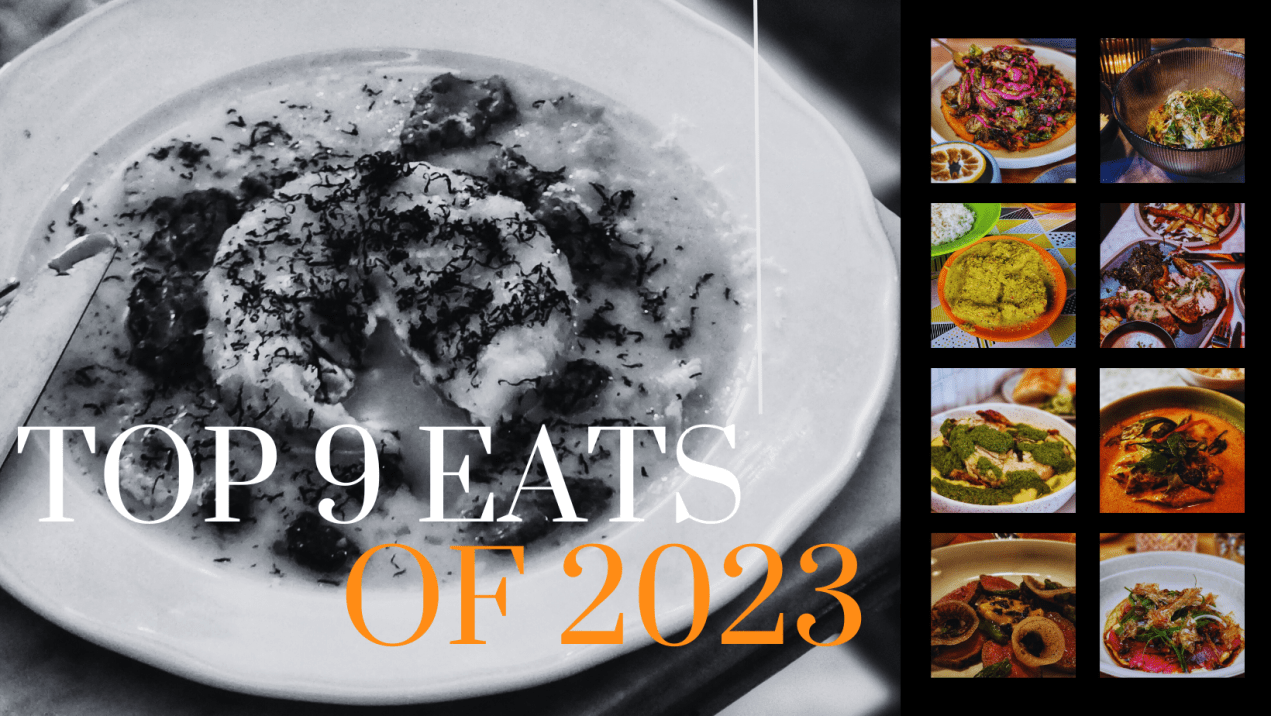
Our Top 9 Eats of 2023

Visit our Instagram page

By Michael White and Kley Klemens
Photos by Kley Klemens

Jewkarta may be only three years old, but we’ve visited a staggering number of restaurants, eaten and guzzled an overwhelmingly vast selection of food and beverages, and made the acquaintance of countless culinary professionals in this short period of time. And we’ve loved every minute of it!

2023 was, by far, our most interesting year yet, for reasons good (Kley’s long-overdue return to his native Indonesia; some of the greatest dining experiences we’ve had as a couple) and not (Michael’s sudden health downturn, which prevented him from participating in most of Jewkarta’s activities for the first half of the year).

But our annual Top 9 is all about emphasizing the positive — specifically, the most delicious and memorable dishes we ate throughout the past 12 months. Scroll down to discover them all. And whether you began following us three years or three minutes ago, we thank you for being a part of our gastronomic adventures in Metro Vancouver and beyond.

@barhaifa
HAIFA HALF CHICKEN

Chicken is often little more than a chef’s compromise for unadventurous customers. But the iteration at this new (and spectacular) Middle Eastern restaurant is one of the best we’ve had, thanks to its secret seasoning blend and a gravy good enough to redeem the foulest of fowls.

@liviasweets
SUNDAY ROAST PORCHETTA FOR TWO

Italy’s beloved pork dish (boneless, with shatteringly crisp skin and infused with the flavour of its own fat) is transcendent at this popular Commercial Drive eatery, its inherent richness amplified by a bed of velvet-soft polenta, and contrasted with the bracing heat and acidity of an emerald salsa verde.

@bar.gobo
ROASTED STRIP LOIN

The ever-changing menu at this edge-of-Chinatown wine bar means this simple yet perfectly executed dish from chef @so_j_one may not return for a long time, if ever. So excuse our conflicting emotions: thrilled that we were able to experience it, sad that we may never again.

@chupitococteleria
TOSTADA DE ATUN

This trailblazing seasonal dining space (located in an alleyway, and open only during warmer months) specializes in elevating familiar Mexican dishes to a state of luxury. We utterly devoured this photogenic tostada, which arrived topped with tuna, ginger mayonnaise, spicy soy sauce and fried katsoubuchi.

@elephantinvancouver
PORK NECK

Are we able to confirm that chef @justin.song.ell is human? His endless creations, which he invariably cooks and plates alone at a small prep station behind Elephant’s diner-like counter, are bizarre in theory yet astounding in reality. Berkshire pork neck flavoured with FIFTY-FOUR different types of Thai herb? Whatever you say, chef!

@zarakvancouver
BRUSSELS SPROUTS

Whoever discovered that the vegetable responsible for ruining countless childhood Thanksgivings could be fully redeemed by a swim in a deep fryer deserves the Nobel Peace Prize. For piling them onto a pool of red-pepper hummus and anointing them with a neon-pink masala sauce that looks like it belongs on a birthday cake, Zarak deserves the MacArthur Genius Grant.

@caffelatana
RAVIOLO

A single plate-sized pasta pillow, stuffed with black truffle, ricotta and herbs. Almost indecently rich and savoury, Kley continues to daydream about it as if it were a millionaire daddy offering to whisk him away to a private resort on the Amalfi Coast.  

Somewhere in North Sumatra, Indonesia (no website)
NANIURA

A highlight of Kley’s visit to his homeland: tilapia ceviche marinated in kafir lime juice mixed with torch ginger (a perennial plant native to Indonesia), turmeric, candlenut, Andaliman pepper, coriander and more. Another reason why Kley is baffled by Indonesian cuisine’s low international profile.

@hujanlocale
ACEHNESE GRILLED OCTOPUS

Another Indonesian dish — created by chef @meyrickwill, who helms the kitchen at this must-visit restaurant in Bali — the complexity of which Kley can’t describe or compare to anything he’d had before. Acidic and spicy, creamy yet light — Kley asks, “How is it that I’m Indonesian and Chef Meyrick isn’t??”

Standard
Italian

InterJew #2: Vish Mayekar (chef, Caffè La Tana, Pepino’s Spaghetti House)

Visit our Instagram page

By Michael White

Vish Mayekar may be the most driven chef we’ve met in the history of Jewkarta.

We were introduced to him during our unforgettable first dinner at Caffè La Tana, shortly after pandemic dining restrictions had been lifted and the soon-to-be multi-award-winning restaurant was hosting a full house of jubilant patrons who were thrilled to finally be experiencing in-person dining again. Vish continues to be chef at Caffè La Tana and its adjoining neighbour, the historic and revitalized Pepino’s Spaghetti House — both of which are almost always bustling. Prior to this, he had cooked in his native Mumbai as well as in San Antonio, the Niagara region, and Toronto.

Additionally, in recent years Vish has been executive chef at the American Pavilion at the Cannes Film Festival, was a competitor on Top Chef Canada, and is seemingly always participating in a culinary event at home or abroad.

This interview has been edited for brevity and clarity.

What’s your earliest memory of being taken to a restaurant?
It was back home in Mumbai, and it was and still is my parents’ favourite restaurant. It’s an Indo-Chinese restaurant called Gypsy. And to this day — every time they go, and every time I’m back home and I go with them — they get this one crab dish, which is prepared in an Indo-Chinese way where the crab is filled back into its shell. I remember being super young — I think I would’ve been eight — and seeing it for the first time and just being blown away by how it was done. That memory of me eating a stuffed-crab dish with my parents is the first restaurant I recall. The last time I was in India — unfortunately, a very long time ago — we went and had the same dish. My parents were there a couple of weeks ago and they had it.

When did you know you wanted to work in the restaurant industry?
Grade nine. I looked up to my dad and I said, “Dad, I want to be a chef.” And he said, “All right.” I’m blessed to have the parents I do, who are super supportive and they never questioned me. They were like, “Great — you’re gonna be a chef!” I’ve never had a different job in my life.

I went to culinary school back home and wanted to go to Europe or wherever. And while doing school, I had the opportunity to do a co-op in Texas. So, I lived in San Antonio for half a year, finished that and went back home. And that’s when I knew I had a travel bug in me. I’m not a tree; I’m not going to spend the rest of my life in one spot. I wanted to go to Switzerland or Italy, but the timing wasn’t right. And Niagara College in Ontario — its name came up and I thought, “I’m gonna give it a shot. I’m not going to live in Canada forever. I’ll do a couple years of school, maybe a couple years of working, and then move on.” Ten years later, here I am: a citizen of Canada and I absolutely love it. I always knew that if I went to Canada, I’d move to the west coast. I moved to Vancouver seven and a half years ago and I haven’t left.

What drew you to the profession in the first place?
I think coming from an Indian background and being surrounded by food and desserts and anything to do with cooking. In Indian culture, we have so many ceremonies and festivals and cultural things that we do throughout the year, and I always joke that those are just reasons for us to cook and eat. I remember deciding, before grade nine, that I was going to be doing this forever. I remember being in the kitchen with my mom and my grandmother, always hanging out in there, and it just felt natural. I was always intrigued by the cooking that was happening in the kitchen. As long as I can remember, the kitchen felt like where I belonged.

Is being a chef or a cook viewed as an honourable profession in India?
Yes. It’s not degraded. Indian food has come such a long way. It’s not like a lot of other cultures, where you see cooking being a low-grade job. That’s absolutely not what it is in India. Indian cuisine is one of the best and most renowned in the world, and there are 1.5 billion people in India, so we love our food.

When did you start learning about cuisines from other parts of the world — in particular, Italian?
Throughout my travels and going to school in Niagara. And then just a lot of R and D [research and development]: a lot of cookbooks, a lot of TV shows, and a lot of studies and being able to replicate dishes. It’s continuous growth. I wouldn’t call myself a master chef in Italian cuisine by any means, but there’s constant growth that goes with it, and that’s what keeps me excited about being a chef.

Did you start travelling more after arriving in Canada?
Definitely. More than ever. I absolutely love it. The things that matter the most to me in my life, other than my parents, are food, wine and travel.

In those travels, what have been some of the most revelatory experiences, in terms of discovering a type of cuisine or a specific dish?
Going to the south of France and being a part of the Cannes Film Festival for the first three years, and then being offered to run the program and be the chef at the festival. For the last three years, I’ve been the head chef at the American pavilion. It was an incredible opportunity. It’s one of the toughest jobs that I do and it’s only a two-week gig. It takes a certain type of person to go there and work 18 to 20 hours a day for two weeks straight, and then come back to the reality of your regular cooking. I’m so proud of being able to do that but, yeah, it’s tough!

Every cook and every chef that comes from my generation, we all look up to French cuisine like it’s the be-all and end-all — and, in a certain way, it still is in terms of the basis of cooking. But being in France and actually being able to experience the southern French cuisine and being able to not only cook French cuisine in France but then, from France, going to Barcelona and really, really taking in the Spanish street food — it was absolutely incredible. I’ll never forget that food journey that I took there, having five meals a day.

Earlier this year, I spent five days in Mexico and that was probably the best food trip I’ve ever taken in my life. I had seven meals a day, from 10 a.m. tacos on the street to 4 a.m. tacos on the street. It’s absolutely incredible, the food and culture in Mexico City.

What was your first restaurant job when you arrived in Vancouver?
I started at Cactus Club.

That’s not the answer I was expecting!
Nobody does. Everyone is expecting fine dining, and I did that a lot in Ontario. But when I moved here, the opportunity at Cactus Club came up, I took it and I was there for quite a time, until I was offered to run a winery up in the Okanagan. I was the chef for the Fitzpatrick [Family Vineyards]. I was supposed to go back and do that again for the next season and then, “Thank you, COVID.” But then I got the opportunity to be a chef for a nutritional meal-prep company, which I never thought I’d do, but it was a cool opportunity to be working with nutritionists and dietitians.

After that, I got a scholarship to do my WSET [Wine & Spirit Education Trust], then I got a phone call from Paul [Grunberg, owner/operator of Caffè La Tana, Pepino’s Spaghetti House and Savio Volpe], and two and a half years ago I took over Pepino’s and Caffè La Tana.

What are some of the most significant things you’ve learned during your time here?
I think, overall, just being a better person, a good chef and being able to run a tight team. I’ve come from restaurants and hotels where I had cooks over cooks over cooks, but over here it’s more like a family — a very small and tight team. I’ve learned to manage two operations at the same time and run them both successfully. I’m super proud of that. It’s not been easy, but I’d do it again.

How do you think the Vancouver restaurant scene has changed or evolved since you moved here?
I’ve seen growth in Vancouver where a lot of amazing restaurants have popped up, and a lot that have already existed have found their stride and are doing incredibly, and a lot of small restaurants have found their spotlight. There was good food in Vancouver before, but in the time I’ve been here, chefs that deserved recognition have started to get it throughout different accolades, including Michelin. We’re one of only seven cities in all of North America to be included in the Michelin Guide. That’s huge.

What’s one restaurant in Metro Vancouver that you think is unfairly underexposed?
L’Abattoir. For who they are and what they’re doing, that’s one restaurant that needs to have a higher level of recognition. It’s an institution that’s been around for a long time; the consistency of the food and the creativity involved in it… That was the first fine-dining restaurant that I went to when I moved here. They do an incredible job. I think everyone should go there.

Do you sleep?
What is that? (laughs)

This is nothing to brag about, and every chef and everybody in the hospitality industry should take care of themselves. It takes a toll on you before you realize. I’m the worst person to be telling people to rest more, because I’m very bad at it. I sleep very little, but I’m still grinding it because I’m happy and I want to. No one’s forcing me.

Standard
Food Truck, Italian

Review: In Vacanza Pastificio

Visit our Instagram page to see more photos

By Michael White

Until recent years, a longstanding cliché about Manhattanites was that a meal would have to promise near-religious transcendence to compel them to travel across a bridge into one of New York City’s four other boroughs.

Yet while the Lions Gate and Ironworkers Memorial bridges that separate Vancouver from North Vancouver aren’t exactly the equivalent of the Brooklyn or Queenboro in terms of undue schlep, they nevertheless represent a psychological hurdle to many of us who live south of the Inner Harbour.

All of which is to say that Kley and I had high expectations of In Vacanza Pastificio, an (obviously) Italian-themed food truck that was, on the night we tried it, parked in front of the craft distillery Sons of Vancouver (SOV) on the North Shore.

To be clear, the very idea that we considered ourselves to be going out of our way was ridiculous. The journey from our apartment in South Burnaby to SOV’s door was less than 20 minutes by car — a fraction of the time we’ve spent on transit for take-out fried chicken we then turned around and brought home.

We discovered In Vacanza Pastificio (IVP) — or, rather, they discovered us — via Kley’s many recent Instagram posts about his vacation in Florence and Rome. No sooner had he come back than IVP proprietor Eryn MacKenzie flew there with chef Anthony Cardoza to conduct a three-week “research and recipe development” expedition that took them from Milan to Venice, Cinque Terre to Naples, the Amalfi Coast to Sicily. Erin and Kley subsequently commiserated via DM about their mutual withdrawal from la dolce vita after returning home. Kley, in fact, has remained in mourning for more than two months, consoling himself with Italian pop songs, a newly established aperitivo ritual, and an ongoing search for local restaurants whose food and atmosphere might replicate the revelatory gastronomic experiences he had overseas.

In this regard, Kley and Eryn have much in common. Eryn was moved to create IVP after a backpacking trek through Italy in early March of 2020, during which she learned to make scratch pastas and sauces. Returning to Vancouver at the exact moment the pandemic was wrapping its imprisoning arms around the world, she resolved to share her newfound kitchen skills with local diners, and charge prices that hew closer to what you might pay for a life-changing bowl of rigatoni from a nondescript street vendor on Campo de’ Fiori (which is to say, not very much at all). In vacanza, by the way, means “on vacation.”

Despite a burgeoning law career, within months Eryn had launched IVP, which won awards for its food and unwittingly became a focal point of North Vancouver’s outdated policies regarding mobile eateries. Kley and I didn’t know this when we rolled up for our first taste a few weeks ago. We only knew we were hungry.

IVP’s current arrangement is that you can get your food to go from their window or have it brought to you while you enjoy drinks inside SOV’s cramped, lively and utterly lovely tasting lounge. We fully intended to make an evening of it, so we approached the scenario appropriately: we claimed the last remaining pair of seats at the bar, took delivery of some delicious drinks, and proceeded to wildly over-order from IVP’s menu.

Except, we soon realized, we didn’t over-order, because everything brought to us was so humbly yet overwhelmingly excellent that we don’t want to even contemplate having passed it up. Out of the sort of disposable paper trays that might typically hold sliders or deep-fried Oreos from a midway concession, we ate pastas that were the match of virtually anything we’ve had elsewhere in and around Vancouver — and, in Kley’s telling, the match (or very near to it) of some of the pastas he had in Italy.

The “Pasta Tasting Flight,” made up of four half-size orders, is a thoughtfully provided solution for those who, like us, are theoretically greedy yet realistic about their stomach’s limitations. We chose Cacio e Pepe, Bucatini all’Amatriciana, Spaghetti al Pomodoro, and Linguine Puttanesca — each a purposely, perfectly understated creation that, in the proper Italian tradition, serves to showcase the quality of a select few ingredients rather than trying to dazzle with complexity. That means authentic San Marzano tomatoes in the sauce, Tipo “00” flour and local free-range eggs forming the noodles, and fresh basil leaves and a modest showering of Parmigiano Reggiano when the dish calls for it. There was also a simply dressed salad of arugula and tomato hiding under a luscious puck of specially imported burrata that tasted like an evocation of the sun-filled springtime Vancouver seems determined to not give us this year.

All of this blissful indulgence was consumed in the happy contentment of SOV’s above-mentioned tasting room, where their exemplary spirits, made just steps from where we sat, form the basis of cocktails that were worth a bridge-crossing on their own. (I’d like it noted that the Vito Corleone shouldn’t be taken off the list under any circumstances.) Service was as relaxed as conversation between long-time friends, the playlist a deft blend of rock both classic (Bruce Springsteen) and cult (Jonathan Richman), and the entire night the very essence of what Kley and I people hope every meal out to be.

Cross a bridge? We’d have been no less pleased if we’d crossed an ocean.

In Vacanza Pastificio
1427 Crown St., North Vancouver
236-330-9696
invacanza.ca / Instagram: @invacanzapasta

Sons of Vancouver
1431 Crown St., North Vancouver
778-340-5388
sonsofvancouver.ca / Instagram: @sonsofvancouver

(Photo: Kley Klemens)

Standard
Italian

Review: Caffé La Tana


Click here to see more photos
and click here to see our video!

By Michael White

It was roughly 90 minutes after walking into Caffé La Tana — when three plates of food had been delivered, and we’d drained our first cocktails and were making quick work of a bottle of wine we had no intention of ordering until the spirit of the evening swept us up — that Kley and I exchanged an incredulous glance that essentially said, “Is this happening?”

Because what was happening was nothing less than a convincing approximation of life as we vaguely remember it from almost two years ago, but without the reckless disregard for public health such a statement might imply. It was dreamlike and magical and slightly disorienting — much like almost every aspect of our meal.

When we first visited earlier this year, largely to investigate the Italian-style donuts Kley had seen online (and which didn’t disappoint), Caffé La Tana’s dine-in service was suspended, as it was everywhere else, and was operating solely as a grocery and take-out counter. This has always been part of its business model — the vintage shelves and refrigerated case inside the entrance have been stocked since day one with cheeses, condiments, dried pastas, imported canned seafood, and much more. And you can get, say, an excellent breakfast sandwich with prosciutto, a kale salad or a house-made pasta to go.

But last week, we opened the door onto a very different scene. It was essentially a civilized party in full swing — the bustling Italian café its owners had always intended this space to be — for which the price of admission was providing ID and proof of vaccination. While servers were masked, as were patrons when they stepped away from their responsibly-distanced table, we otherwise felt as if we’d somehow time-travelled backward to the innocent, happy-go-lucky heyday of February 2020.

Every table had been claimed (there aren’t many), but we were happy to graze and gulp around the edge of a large communal standing table — in fact, when seats did become available, we elected to stay where we were. (Similar to Mount Pleasant’s Como Taperia, Caffé La Tana encourages a Eurocentric casualness we’d love to see more North American eateries adopt.)

From the compact but diverse evening menu, we chose a meltingly tender Albacore tuna crudo (pictured above), simply yet impeccably dressed with lemon, basil oil and flecks of Calabrian chili; and a basket of ingenious Cacio e Pepe fritti (the invention of chef Phil Scarfone), in which the classic cheese-and-pepper pasta is battered and fried like arancini.

Co-owner Paul Grunberg — a familiar sight from sister restaurants Savio Volpe and Pepino’s Spaghetti House — implored us to order an off-menu special that would “knock [our] fucking socks off”: a beef tartare atop which he shaved a possibly immoral amount of black truffle. And it was at this point that the night tipped over into a sort of benign surreality. The intense deliciousness of everything we were putting into our mouths, combined with an atmosphere borne of profound gratitude that this sort of gathering together is possible again (which led us and our fellow diners to talk to one another as if we were all long-lost friends), seemed to envelop the room in a glow of contentment so total, we were reluctant to ask for the cheque for fear of breaking the spell.

Fortunately, there was still to come a daily pasta special (striped ravioli with shrimp, confit garlic and a lemon-butter sauce — as good as it sounds), a more-chocolate-than-chocolate Torta Tenerina with Amarena cherries and mint, and a pair of utterly transporting grappas we tried at the urging of chef Vish Vaishnav. In total, it was the sort of experience for which you become nostalgic while it’s still happening.

Outside on Commercial Drive and in the wider world, life was up to its usual nonsense: all manner of heartbreaks and infuriations and petty grievances and people who won’t compromise their “freedom” for the greater good and just get the fucking shot already. But those things weren’t welcome inside Caffé La Tana, and it was as good as a vacation at a fraction of the cost and effort.

Caffé La Tana
635 Commercial Dr., Vancouver
604-428-5462
caffelatana.ca / Instagram: @caffelatana

(Photo: Kley Klemens)

Standard
Italian, Pizza

Review: Anthem Pizza

Watch the video review here!

By Michael White

Is pizza something to be taken seriously? You may not think so, and fair enough.

Pizza, after all, is one of the most democratic, easily accessible foodstuffs we have. Whether you have billions of dollars to your name or are one lapsed paycheque from eviction, you probably have the means to acquire some. Not even “expensive” pizza is expensive in the grand scheme. (I don’t count the sort of three- and four-figure stunt pies that come bedecked with gold leaf or a forest’s worth of black truffle. Those exist only for bragging rights, not the pleasure of eating.) What could be serious about something available to everyone, virtually everywhere? Pizza is so lacking in seriousness that Pizza Hut exists — the physical manifestation of a joke, albeit a cruel one. (And before you accuse me of snobbery, know that I’m a Domino’s apologist.)

And yet…. If pizza isn’t serious, consider how you feel when you take a bite of disappointing pizza. The heartbreak. The indignation! The betrayal! How could so ostensibly reliable a comfort breaks its promise? It doesn’t matter where you are or how much you paid — a large $12 delivery pie, ordered in a drunken haze at half past midnight, owes itself to you to be delicious because this is pizza’s one job. Pizza is serious, you see, because we love it like few other things, and love is serious. Vegans love pizza so much they’ve bent over backward to reengineer it to keep it in their lives. (Acknowledge yourselves, Virtuous Pie.) Pizza is so serious a non-profit association exists in Italy solely to define and uphold the hyper-specific traditions of Neapolitan pizza-making. (Vancouver’s own Nicli Antica Pizzeria and Via Tevere, and Cotto, in both North Burnaby and Surrey, meet their criteria. Prior to 10 years ago, no Greater Vancouver pizzerias did.)

Walking a tightrope between serious and its polar opposite is Anthem Pizza, which launched not long ago, in the middle of November. There is no storefront; instead, takeout and delivery are conducted from the kitchens of The Five Point and Park Drive, two of Anthem owner Matt Thompson’s other establishments. (His burgeoning empire also includes Alphabet City and The Cannibal Café.)

Anthem arrives wrapped in a three-pronged concept so novel, amusing and kind-hearted, it threatens to eclipse their food. Prong one: In keeping with The Cannibal Café’s defining rock ’n’ roll aesthetic (it’s named after a song by Canadian punk trailblazers SNFU, and the walls are papered with vintage gig flyers), each of Anthem’s 14-inch pies is a tribute — in name, if not in spirit — to a band, album or song. Peruse the menu and find nods to Iggy Pop (the “Blah Blah Blah”; Alfredo sauce, mozzarella, fior di latte, Grana Padano, provolone, and gorgonzola), Beastie Boys (the “Sabotage”; mozzarella, chorizo, pepperoni, roasted chicken, and prosciutto) and the Clash (the “Stay Free”; tomato sauce and mozzarella). How a vegetarian pie came to be named after Suicidal Tendencies’ hardcore perennial “Institutionalized” presumably involved a late-night drinking game and a droll sense of humour.

Prong two: Partial proceeds from every pizza go to charitable causes, which rotate every three months. (At the time of this writing, the BC Children’s Hospital Foundation and the musician-focused Unison Benevolent Fund are the beneficiaries.) Prong three: Every pizza box wears a pasted-on graphic created by a local artist; those artworks are available as posters and T-shirts from Anthem’s online shop, where proceeds also go to charity.

Fortunately, Anthem’s wares aren’t a mere afterthought to clever marketing. Their pizzas aren’t about to unseat the likes of Via Tevere or Pizzeria Farina from the mountaintop where they so long ago planted their flags, but they aren’t trying to. These are populist pizzas — better than they have to be and more than good enough. You won’t find the seductive charred blisters of a wood-fired oven, nor a sauce made with the unmistakable tang of San Marzano tomatoes. What you will find is a lovely, appropriately uncomplicated Margherita pie (named after Motorhead’s “Ace of Spades,” because why not), topped with good-quality fior di latte and fresh basil leaves; and the David Bowie-acknowledging “Hunky Dory,” essentially a hifalutin interpretation of the always-controversial Hawaiian pizza, elevated by the addition of banana pepper, mildly funky prosciutto, and a bright pineapple jam that isn’t as cloyingly sweet as the Del Monte chunks typically used for this purpose. (Kley, incidentally, lost his mind over this one.)

Anthem also offers a variety of wings — the very same that have accompanied so many pitchers of beer at The Five Point (I recommend the Black Dragon flavour, basted with a mix of soy and Sriracha; $14) — and a pair of salads ($14 each), one of which earns extra points for being named J.J. Kale. Frankly, J.J. Cale isn’t the least bit punk rock, but then neither is salad.

Anthem’s pizzas currently cost $18 to $24 each, which is notably more than you would pay for some of the city’s most revered pies. But in the comfort of your home, with or without your bubble, and alongside a sympathetic adult libation (we murdered a bottle of this bargain Okanagan red blend), these pizzas are very easy to love. And all the more for the good they seek to inject back into the community. In times like these, could such a goal be any more serious?

Anthem Pizza
Take-out only at 3124 Main St.
and 1815 Commercial Dr., 3–10pm
604-425-1129
anthempizza.ca / Instagram: @anthempizza
Delivery platforms: DoorDash, Skip the Dishes, Uber Eats

(Photo: Kley Klemens)

Standard